Bullish Kicking
Updated Aug 26, 2026 · Reviewed by Terence Scott, founder
- Signal
- Bullish Reversal
- Reliability
- High
- Rarity
- Extremely Rare
- Confirmation
- Optional
- Trend Position
- Any
- Best Timeframes
- Daily+
On this page
Bullish Kicking is a two-candle reversal pattern built from a gap between two marubozu candles — candles with little to no shadow, meaning the open and close sit at or near the session's high and low. A bearish marubozu is followed by an unfilled gap up into a bullish marubozu, with no price overlap between the two candles at all. Because that exact combination is uncommon, genuine examples are extremely rare, but the clean, decisive shift in control they show has made this one of the more respected reversal signals in candlestick analysis.
Recognition Criteria
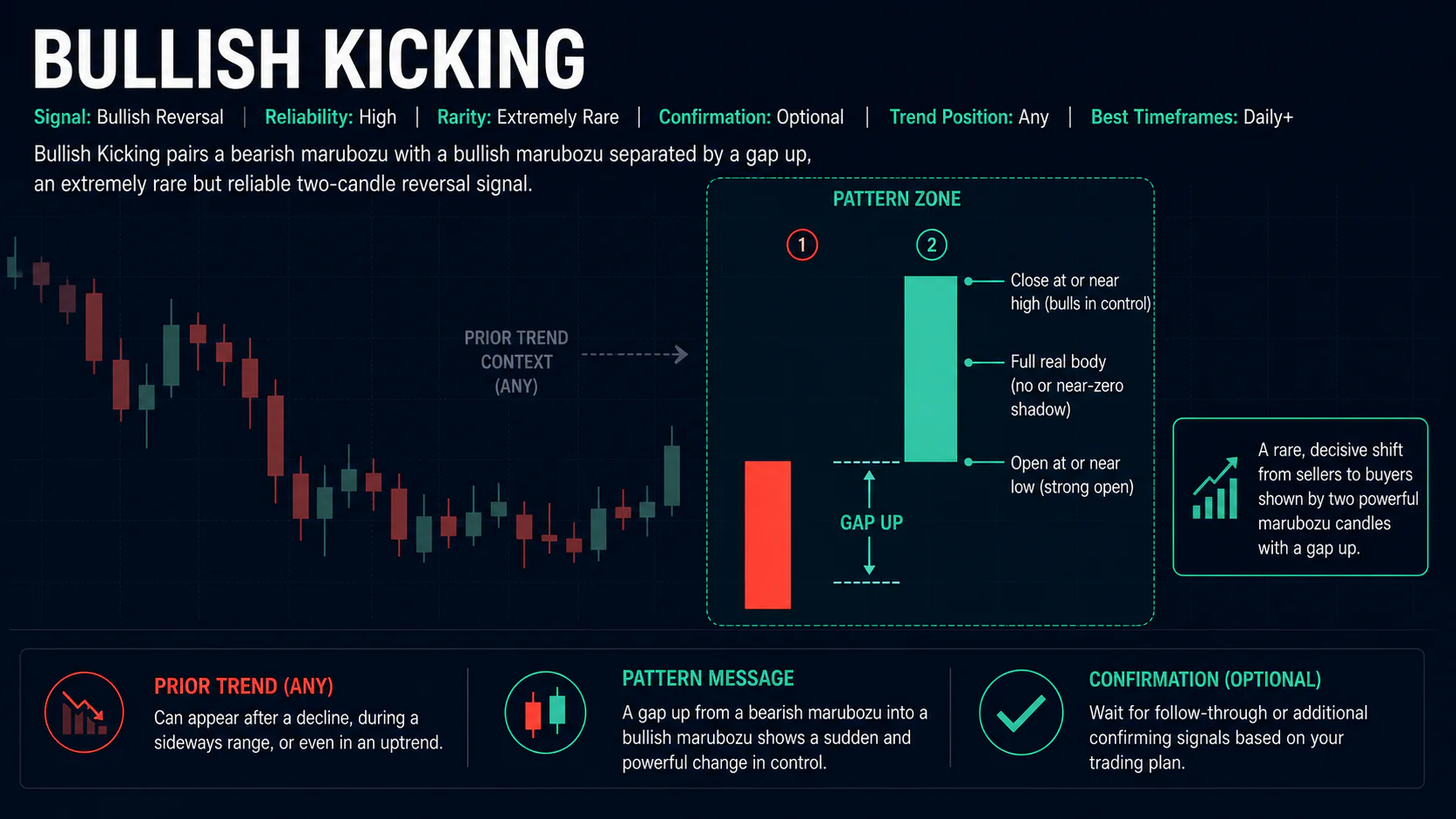
First candle: a bearish marubozu, or near-marubozu, opening at or near its high and closing at or near its low, showing sellers in control for the entire session.
Second candle: a bullish marubozu, or near-marubozu, that gaps up from the first candle, opening at or near its low and closing at or near its high.
The gap: there must be no price overlap between the two candles — the second candle's entire range sits above the first candle's entire range.
Trend context: unlike most reversal patterns, Kicking does not require a preceding trend. It can appear after a decline, during a sideways range, or even within an uptrend, and its significance comes from the abrupt change in control rather than from reversing an established move.
Market Psychology
The first candle shows one-sided selling from open to close, with no meaningful buying interest at any point in the session. The gap up that opens the second candle immediately invalidates that selling — anyone who sold into the first candle's close is now underwater — and buyers then control the entire second session as well, closing near the high. The pattern is unusual because both sessions show complete, one-directional control with no tug-of-war candle in between; the shift happens instantly at the open of the second day. Gaps of this kind are frequently tied to a market-moving news event or earnings surprise, since an ordinary session rarely produces a clean gap between two marubozu candles on its own.
Trading the Pattern
Entry
Because the pattern is essentially confirmed by its own structure, many traders act once the gap is visible and the second candle is tracking toward a marubozu close — near the open if the gap and early trading support it, or at the close once the full session confirms the pattern.
Stop Loss
A stop below the low of the second candle is the standard placement; a break back into the gap undermines the pattern's premise. Some traders treat a partial gap-fill (for example, the gap being retraced by half) as an earlier warning sign rather than waiting for a full breach.
Targets
Project the size of the gap upward from the second candle's close as a starting point, then look to nearby resistance or prior swing highs for a more grounded target. Because the pattern can precede an extended move when the underlying catalyst is significant, trailing a stop to let a winning position run is often more effective than a single fixed target.
Confirmation and Indicators
The clearest confirmation is simply the gap holding — if subsequent sessions don't fill back into the first candle's range, the pattern's implication stays intact. Volume on the second candle that is well above the recent average adds confidence that the move reflects broad participation rather than a thin, easily reversed gap. RSI and MACD are secondary here since the pattern is usually driven by a specific news catalyst rather than a gradual momentum shift, but a MACD crossing bullish around the same time doesn't hurt the case.
Common Mistakes
Accepting partial gaps: if there is any overlap between the two candles' ranges, the pattern is not a true Kicking pattern — it may instead be an engulfing pattern or belt-hold variant.
Ignoring shadow size: candles with sizable shadows on either side dilute the marubozu requirement and weaken the signal.
Chasing the gap after it has already run: entering well after the second candle has extended far from the gap reduces the risk-reward of the trade.
Not respecting the stop: because the pattern's validity depends entirely on the gap holding, a meaningful fill of that gap should be treated as an invalidation signal rather than something to wait out.
FAQs
How rare is the Bullish Kicking pattern?
It's one of the rarest candlestick patterns because it requires two consecutive marubozu candles with a completely unfilled gap between them — a combination that doesn't occur often in normal trading conditions.
Does the pattern need a preceding trend?
No. Kicking is one of the few candlestick patterns that doesn't depend on trend context; its significance comes from the abrupt reversal of control at the gap.
What usually causes the gap?
Gaps this clean are typically tied to a specific catalyst — earnings, a regulatory decision, or major company news — rather than ordinary supply-and-demand drift.
What invalidates the pattern after it forms?
A significant retracement back into the gap is the main warning sign; if price fills a large portion of the gap, the clean break in sentiment the pattern relies on is being undone.
How does Kicking differ from a bullish engulfing pattern?
An engulfing pattern has overlapping ranges, with the second candle's body swallowing the first candle's body. Kicking requires a full gap with zero overlap between the two candles, plus marubozu-like shape on both.
Conclusion
Bullish Kicking is a simple pattern to define but a demanding one to find: two marubozu candles of opposite color separated by a clean, unfilled gap. When it appears, it reflects an abrupt and complete change in control rather than a gradual shift, which is why it doesn't need a preceding trend to be meaningful. Because genuine examples are rare and usually tied to a specific news catalyst, treat the reason for the gap as part of your analysis, and manage the position around whether the gap holds.