Bullish Abandoned Baby
Updated Aug 26, 2026 · Reviewed by Terence Scott, founder
- Signal
- Bullish Reversal
- Reliability
- High
- Rarity
- Extremely Rare
- Confirmation
- Optional
- Trend Position
- Downtrend Bottom
- Best Timeframes
- Daily+
On this page
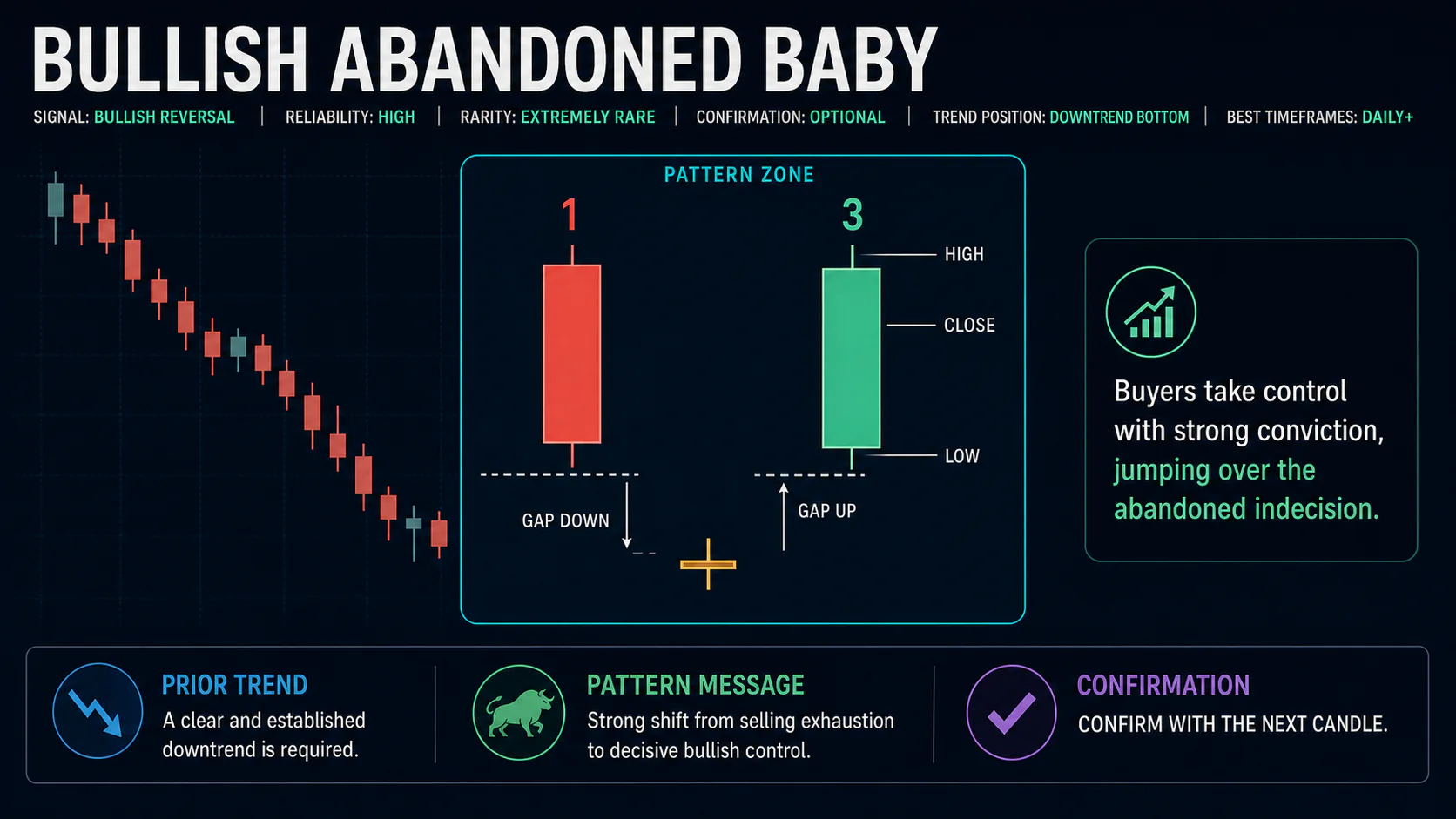
A bullish abandoned baby is a three-candlestick reversal pattern built around a small-bodied middle candle, typically a doji, that is completely isolated from the candles on either side by gaps, with no overlap in trading range on either side. The isolated middle candle appears to be "abandoned" in price space between a large bearish candle before it and a large bullish candle after it. It is one of the rarest reversal patterns in candlestick analysis, and true examples with clean, non-overlapping gaps on both sides are genuinely uncommon in liquid markets.
Recognition Criteria
First Candle
A substantial bearish candle that continues the existing downtrend, ideally on above-average volume. This candle should have a meaningful real body and represent real selling pressure, not a minor down session, since the strength of this candle helps establish just how far sentiment later has to travel to reach the third candle.
Second Candle
A small-bodied candle, ideally a doji, though a small spinning top can also qualify, that gaps down so its entire trading range, including shadows, sits below the first candle's low. This candle represents the moment of maximum indecision, where selling pressure has largely exhausted itself but buyers have not yet stepped in with conviction.
Third Candle
A substantial bullish candle that gaps up so its entire trading range sits above the second candle's high, closing well into, or above, the first candle's range. This candle demonstrates buyers asserting control decisively enough to jump entirely over the isolated middle session.
Critical Requirements
- Complete isolation: the middle candle's full trading range, including shadows, must not overlap with either neighboring candle. Any overlap disqualifies the pattern.
- Established downtrend: the pattern needs a genuine prior decline, not a minor pullback, to carry reversal significance.
- Small middle body: a doji is the strongest form; a small spinning top is an acceptable but somewhat weaker variant.
- Size contrast: the first and third candles should be substantial relative to the isolated middle candle.
- Volume pattern: the most convincing examples show elevated volume on the first candle, noticeably lower volume on the isolated middle candle, and renewed volume on the third candle.
Market Psychology
Capitulation
The first candle represents a continuation of selling pressure, often a late-stage or capitulation-style decline where bad news has been largely absorbed and emotional selling reaches a climax. This is the point where the trend still looks, on the surface, like it is accelerating.
Abandonment
The gap down into a small, indecisive candle shows that sellers have largely exhausted themselves and buyers have not yet stepped in with conviction, a genuine pause with little participation from either side. Price discovery effectively happens in a vacuum for that one session, which is what gives the pattern its name.
Reversal
The gap back up into a large bullish candle shows buyers asserting control decisively enough to jump over that entire quiet session. The fact that price never traded at the middle candle's level from either direction is what makes the pattern distinctive: sentiment shifted abruptly enough to leave a gap on both sides rather than a gradual transition.
Variations
Doji middle candle: the textbook and most reliable form.
Spinning-top middle candle: a small real body rather than a true doji; still valid, though considered a somewhat weaker signal since it shows slightly more directional bias than pure indecision.
News-driven formation: the gaps sometimes coincide with a negative catalyst followed by an unexpected positive one, which can explain the abrupt sentiment shift and gives the pattern an obvious external trigger beyond pure technical exhaustion.
Extended-gap formation: the gaps on either side of the middle candle are unusually wide relative to the stock's typical daily range, underscoring how sharply sentiment moved in both directions.
Distinguishing It From Similar Patterns
Because true isolation is a strict, binary requirement, it is worth being deliberate about checking it rather than eyeballing a chart quickly. Overlay the middle candle's full range, including its shadows, against both neighboring candles: if there is any shared price territory at all, the pattern is not an abandoned baby, no matter how small the middle candle's body is or how dramatic the overall three-candle move looks. Patterns that come close but fail this test are usually better described as a morning star or morning doji star, both of which are considerably more common and are generally treated as reliable, if less extreme, reversal signals in their own right. Knowing the difference matters because the abandoned baby's reputation for high reliability is built specifically on the rarity and rigor of the complete-isolation requirement; loosening that requirement to call more setups an abandoned baby would also make the label less meaningful.
Market Context
Because true abandoned babies are so rare, most of what determines whether one is meaningful comes down to the broader setup rather than the pattern's internal mechanics alone. The strongest examples appear after a downtrend that has run for months rather than weeks, at a price level with real prior significance, and alongside signs elsewhere in the market, such as a high-volatility reading, a wave of negative sentiment, or a cluster of oversold readings across related stocks, that a broader capitulation is underway rather than an isolated, stock-specific event. A pattern that meets the technical definition but appears in the middle of an otherwise calm, shallow pullback is a much less convincing example than one that caps off a genuinely stressed period of trading.
Trading the Bullish Abandoned Baby
Because the pattern is so infrequent, most of the preparation happens before it ever appears: knowing in advance which support levels and which stocks you would take it seriously in, rather than trying to work out the right response from scratch the moment a candidate formation shows up on a chart.
Entry
Because the pattern's own third candle already represents a strong, gapped bullish move, many traders treat the completed pattern itself as sufficient confirmation and enter at or shortly after the third candle's close. More conservative traders wait for the gap to hold through an additional session before entering, trading a slightly worse entry price for more certainty that the gaps are not about to be filled.
Stop Loss
Place stops below the low of the isolated middle candle. If either gap begins to fill significantly, the pattern's premise is undermined and the position should be reassessed regardless of where the stop technically sits, since a partially filled gap is a meaningfully different situation than a clean, intact one.
Profit Targets
Given the pattern's rarity and the strength implied by two clean gaps, target meaningful resistance levels, prior swing highs or longer-term moving averages, rather than a narrow, nearby target. Scaling out at intermediate resistance while holding a portion of the position for a larger move is a reasonable approach given how infrequently a genuine setup like this appears.
Confirmation and Combining with Indicators
Because a genuine abandoned baby is rare enough that many traders will only encounter a handful of clean examples over the course of years of watching the markets, it is worth keeping a record of any candidates you do identify, including the ones that ultimately fail the isolation test, purely as a way of sharpening your eye for the next one.
Because the pattern's structure already provides strong internal confirmation, additional indicators are more about context than validation: deeply oversold RSI or bullish MACD divergence heading into the pattern, and formation at a significant multi-month support level, both add confluence. Its rarer three-doji cousin is the tri star, and comparing the two is useful for understanding how isolation by gaps differs from isolation by pure indecision across three sessions instead of the abandoned baby's single isolated session.
Common Mistakes
Most errors here stem from wanting to find the pattern rather than waiting for it, which leads to grading a near-miss as a pass on the isolation requirement when the more disciplined conclusion is simply that no valid abandoned baby has formed yet.
Recognition Errors
- Accepting any small overlap between the middle candle and its neighbors; even minimal overlap disqualifies a true abandoned baby.
- Using a middle candle with a real body that is too large to represent genuine indecision.
Trading and Risk Mistakes
- Trading the pattern during a shallow pullback rather than a genuine, extended downtrend.
- Ignoring gap-fill risk: a significant retracement into either gap weakens or invalidates the setup.
- Using an ordinary position size for a setup this rare, without a deliberate view on how much conviction the pattern actually warrants.
- Chasing the third candle well after it has already extended significantly, rather than accepting that the best entries are close to the pattern's completion.
FAQs
How rare is the abandoned baby, really?
Genuinely rare. The requirement for complete, non-overlapping gaps on both sides of a small-bodied candle means most stocks will show very few clean examples in a given year.
What happens if the gaps partially overlap?
Then it is not a true abandoned baby; it may instead be closer to a morning star or morning doji star, which are more common but generally regarded as somewhat less decisive patterns.
Is confirmation required?
It's optional in the strict sense, since the pattern's own third candle is a strong, gapped move that many traders treat as self-confirming. More cautious traders still prefer to see the gaps hold for an additional session.
What is the main risk with this pattern?
Gap fill. If subsequent trading fills either gap substantially, the abandonment premise, that the market skipped over that price level entirely, is undermined.
Does the pattern work the same way in thinly traded stocks?
Be cautious there. In low-liquidity names, gaps can reflect a lack of buyers or sellers at a given price rather than a genuine shift in sentiment, so the pattern is most meaningful in reasonably liquid stocks and indices.
Is there a bearish version of this pattern?
Yes, the bearish abandoned baby uses the same isolated-doji structure but appears after an uptrend, with a large bullish candle first, an isolated doji gapping up, and a large bearish candle gapping back down to complete the reversal.
How does this pattern compare to a regular gap-and-doji reversal?
Many reversals involve a gap and a doji somewhere in the sequence without ever achieving the complete, two-sided isolation the abandoned baby requires. Those more common variants can still be useful signals, but they should not be labeled an abandoned baby, since that name implies a specific and considerably stricter structure.
Conclusion
The bullish abandoned baby is a rare pattern built on a simple but demanding structure: a small, indecisive candle completely isolated by gaps between a large bearish candle and a large bullish one. Its rarity is precisely why genuine examples are taken seriously.
Recognizing a true abandoned baby, with real, non-overlapping gaps, rather than a superficially similar three-candle sequence is the essential skill for trading it well, since the pattern's reliability depends entirely on that isolation being genuine. Patience is the other half of the skill: most traders will go long stretches without a valid example, and forcing a marginal setup into the label defeats the purpose of having such a strict definition in the first place.