Bullish Unique Three River Bottom
Updated Aug 26, 2026
- Signal
- Bullish Reversal
- Reliability
- High
- Rarity
- Extremely Rare
- Confirmation
- Required
- Trend Position
- Downtrend Bottom
- Best Timeframes
- Daily+
On this page
Bullish Unique Three River Bottom is a rare three-candle reversal pattern that appears after an extended downtrend. A long black candle is followed by a second black candle that pushes to a new low with a long lower shadow before closing well off that low, and a small white third candle then trades entirely within the lower part of the second candle's range. It's a subtle pattern — the third candle doesn't need to close above anything — so most traders treat it as an early warning sign that requires confirmation rather than a standalone signal.
Recognition Criteria
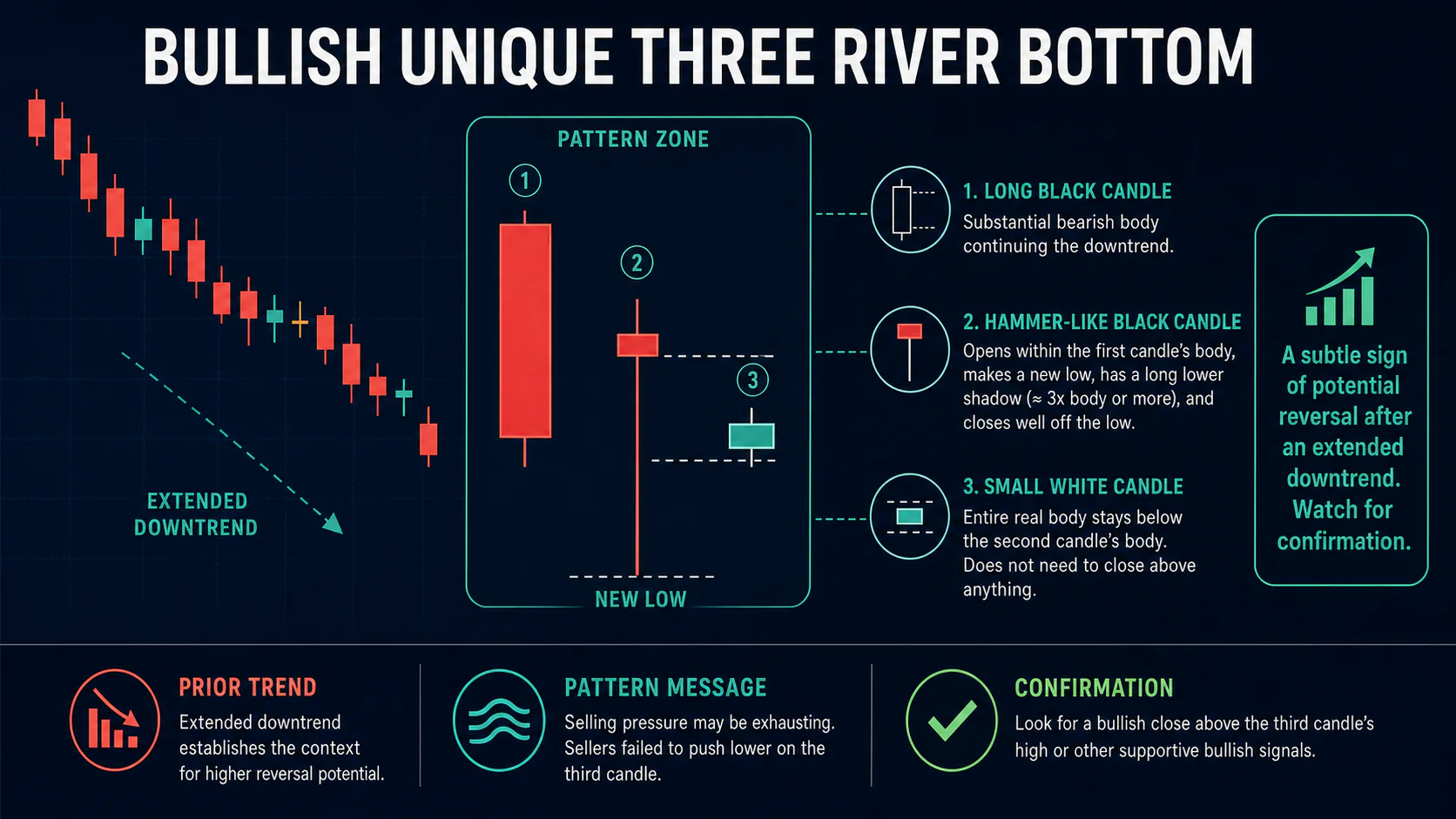
First candle: a long black candle continuing the prevailing downtrend, with a substantial real body.
Second candle: a black, hammer-like candle that opens within the first candle's body, trades down to a new low for the move, and has a long lower shadow — roughly three times the length of its real body or more — but recovers to close well above that low, leaving only a small real body.
Third candle: a small white candle whose entire real body stays below the second candle's real body. It does not need to close above the second candle's close; its significance comes from failing to make a new low, not from closing higher.
Trend context: the pattern needs a genuine, extended downtrend behind it; without one, a small hammer-like candle followed by a small white candle carries little reversal weight.
Market Psychology
The long first candle shows sellers still fully in control. The second candle initially extends that decline to a new low, but the long lower shadow shows buyers stepping in intraday and pushing the close well off the bottom — a classic sign of a selling climax meeting support. The third candle is the quiet part of the story: it's a small, unconvincing white candle, but the fact that it stays contained near the second candle's low and fails to make a new low of its own suggests selling pressure has, for the moment, been absorbed. Because the third candle is so small and undramatic, this pattern reads as an early hint of exhaustion rather than a decisive reversal — which is why confirmation from subsequent price action matters more here than with most reversal patterns.
Trading the Pattern
Entry
Given how subtle the third candle is, most traders wait for a confirming session — a close above the second candle's close or a break above the pattern's high — rather than entering immediately at the third candle's close.
Stop Loss
Place stops below the low of the second candle's lower shadow. That level represents the pattern's low, and a break below it invalidates the support the pattern is built on.
Targets
Use Fibonacci retracements of the preceding downtrend — 38.2%, 50%, and 61.8% — as progressive resistance levels, and favor prior support-turned-resistance zones over a fixed measured-move target given the pattern's tentative nature.
Confirmation and Indicators
Because the third candle alone is a weak signal, confirmation is especially important here: a deeply oversold RSI or stochastic reading during the second candle, followed by a bullish crossover or divergence as the pattern completes, adds meaningful weight. Volume expanding on any subsequent breakout above the pattern's high is a stronger practical trigger than the pattern's raw candle shapes alone.
Common Mistakes
Requiring the third candle to close higher: the defining feature is that its body stays below the second candle's body, not that it closes above the second candle's close — requiring the latter misreads the pattern.
Skipping the lower-shadow check: without a genuinely long lower shadow on the second candle, there's no evidence of the support-testing behavior the pattern depends on.
Trading it without confirmation: given how small and tentative the third candle is, entering purely on pattern completion without a confirming session is higher risk than with most reversal patterns.
Ignoring trend context: the pattern only means something after a real, extended downtrend has set up the selling climax it's describing.
FAQs
Does the third candle need to close above the second candle's close?
No — that's a common misreading. The third candle's body should stay below the second candle's body. Its significance is failing to make a new low, not making a new high.
Why is confirmation required for this pattern?
The third candle is small and doesn't close above anything, so on its own it's a weak signal. A confirming close above the pattern's high, or a supporting momentum reading, is what turns a tentative setup into a tradeable one.
How is this different from a hammer?
The second candle is hammer-like on its own — a long lower shadow with a small body near the top of the range — but Unique Three River Bottom adds the context of a preceding long black candle and a specific small third candle, forming a more complete three-candle reversal story than a standalone hammer.
How rare is this pattern?
Very rare — the specific combination of a new-low hammer-like second candle and a third candle that stays contained below it doesn't come together often.
What invalidates the pattern?
A break below the second candle's low undoes the support the pattern is signaling, regardless of how clean the three-candle shape looked going in.
Conclusion
Bullish Unique Three River Bottom captures a quiet moment in a downtrend: a new low that fails to hold, and a small candle that fails to make a new low of its own. Neither candle is dramatic on its own, which is exactly why the pattern requires confirmation before trading it. Watch the second candle's lower shadow for evidence of support, and let a subsequent breakout, not the pattern alone, trigger the trade.