Bearish Three Black Crows
Updated Sep 2, 2026 · Reviewed by Terence Scott, founder
- Signal
- Bearish Reversal
- Reliability
- Strong
- Rarity
- Uncommon
- Confirmation
- Optional
- Trend Position
- Uptrend Top
- Best Timeframes
- Daily+
On this page
The three black crows is a three-candle bearish reversal: after an advance, three consecutive long black candles march lower, each opening within the previous candle's real body and each closing at or near its session low. The name evokes crows lined up on a branch — an omen arriving in threes. Where a single big down day can be noise, three methodical ones in sequence show sustained, organized distribution, which is why this ranks among the more dependable bearish reversal patterns in the candlestick canon.
Recognition Criteria
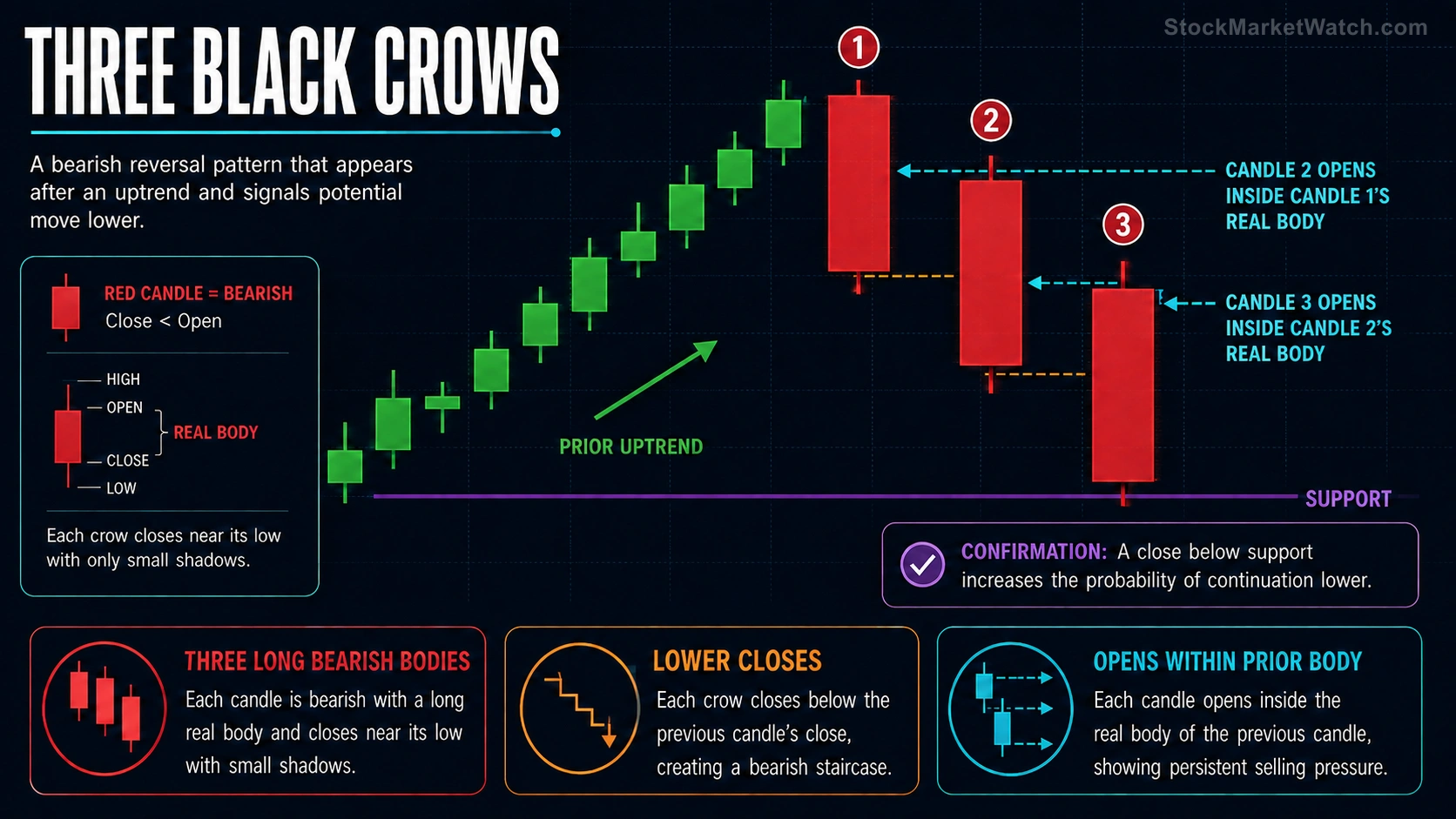
- An established uptrend or a meaningful advance precedes the pattern
- Three consecutive long black candles, each closing below the last — three lower closes in a row
- Each candle opens inside the prior candle's real body — the market attempts a small recovery each morning and fails
- Each candle closes at or near its session low, with little to no lower shadow
- Bodies of roughly similar, substantial size — three decisive sessions, not one crash and two drifts
Market Psychology
The sequence matters more than any single candle. Each session opens slightly higher than the prior close — dip-buyers show up every morning — and each session then sells off to close near its low. Three times in a row, optimism is met with supply and defeated by the close. That rhythm is what separates the crows from a panic gap-down: this is not fear, it is methodical distribution absorbing every bounce attempt. By the third close, the psychology of the preceding uptrend — buy every dip — has been demonstrably broken three consecutive times.
Variations
- Identical three crows: a rarer, stronger variant where each candle opens at or very near the prior close rather than inside the body — no morning bounce at all, just relentless supply.
- Weaker forms: shrinking bodies across the three candles, or growing lower shadows, show selling pressure fading as the pattern progresses — the third candle closing well off its low is a meaningful blemish.
- Related but distinct: the advance block and deliberation are its bullish-side cousins — three white candles weakening in sequence. The crows are already falling; those merely warn the climb is tiring. The direct mirror image is the three white soldiers.
Trading the Three Black Crows
Entry
The pattern's completeness is its practical problem: after three long down candles, price is far from the top and often short-term oversold. Entering short on the third close accepts poor location for high confirmation. Many traders instead wait for the reflex bounce — a weak rally back toward the third candle's open or the midpoint of the pattern — and short the failure, getting confirmation and location.
Stop-Loss
Above the high of the first crow (the pattern's origin) for conservative traders, or above the third candle's open for tighter risk. A rally that closes back above the first candle's open unwinds the whole demonstration.
Targets
No measured move is defined; the prior consolidation zone or support shelf the advance launched from is the natural first objective. For long-holders, the pattern is primarily an exit signal — three failed bounces is the market saying the easy holding period is over.
Combining With Indicators
- Volume: expanding volume across the three candles confirms institutional distribution; contracting volume weakens the case.
- Momentum: if RSI is already below 30 by the third crow, the short entry is late — wait for the bounce. A bearish MACD crossover developing alongside the pattern strengthens it.
- Levels: crows that break a swing low or a major moving average on the way down carry more weight than crows printed inside a range.
Common Mistakes
- Shorting into oversold. The most common error — the pattern confirms at exactly the moment the short-term risk/reward is worst. Location discipline beats signal enthusiasm.
- Counting any three red candles. Three small-bodied drifting candles are a pullback, not crows. The pattern requires three long bodies closing near their lows.
- Ignoring the context ceiling. Crows that begin right at major resistance after an extended advance are the textbook case; crows appearing mid-range after a modest bounce carry far less information.
FAQs
Do all three candles need to be marubozu? No — each should close near its low (little lower shadow), but small upper shadows from the failed morning bounces are part of the pattern's character. Three literal black marubozu in sequence would be an exceptionally strong (and rare) form.
Is confirmation required? Less than for most patterns — the third candle is internal confirmation of the first two. The practical question is entry location, not signal validity.
What invalidates it? A strong close back above the first crow's open. The pattern's message is "every bounce fails"; a successful bounce is a direct refutation.
Conclusion
Three black crows is distribution made visible: three morning bounces bought, three afternoon sell-offs winning. It is among the most trustworthy bearish reversals precisely because it demands so much evidence — and that same evidence cost means the trade is best taken on the bounce that follows, not the close that completes it.