Bearish Dark Cloud Cover
Updated Aug 26, 2026 · Reviewed by Terence Scott, founder
- Signal
- Bearish Reversal
- Reliability
- Moderate
- Rarity
- Common
- Confirmation
- Recommended
- Trend Position
- Uptrend Top
- Best Timeframes
- Daily+
On this page
A bearish dark cloud cover is a two-candle reversal pattern that can appear at the top of an uptrend. The first candle is a strong bullish candle; the second opens with a gap above the first candle's high, then sellers take over and drive the close down into the first candle's body — below its midpoint, but not below its open. That combination of a failed gap higher and a deep close back into the prior session's gain is what gives the pattern its name and its bearish reading.
Recognizing the Pattern
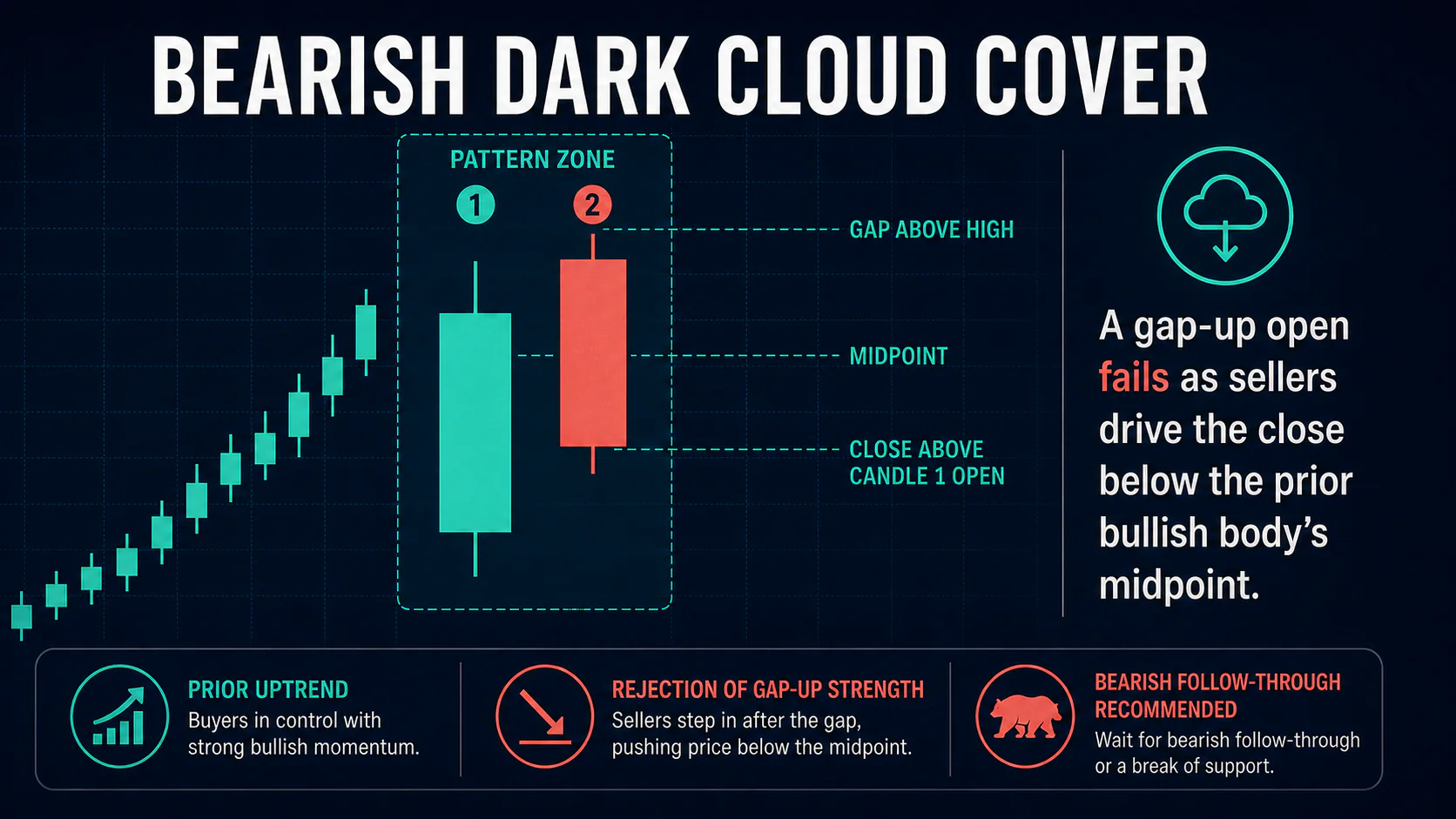
- First candle: a strong bullish (white) candle with a substantial real body, continuing an uptrend.
- Second candle: opens above the first candle's high (a gap up), then closes below the midpoint of the first candle's real body.
- Critical boundary: the second candle's close must stay above the first candle's open. If it closes at or below that open, the pattern is no longer a dark cloud cover — it becomes a bearish engulfing pattern instead, generally read as the stronger of the two signals.
- Context: the pattern needs an established uptrend to carry reversal meaning.
The deeper the second candle closes into the first candle's body — while staying above its open — the more convincing the pattern; classic technical literature treats a close somewhere in the 50-80% penetration range as the productive zone, with the shallow end needing more confirmation. Higher volume on the second candle adds further weight.
The pattern can appear on any timeframe, though it's most often discussed on daily charts, where the gap between sessions reflects genuine overnight sentiment rather than an artifact of very short intraday bars. A dark cloud cover on a weekly chart after a sustained multi-month advance generally carries more significance than the same two-candle shape intraday.
Market Psychology
The first session shows continued bullish conviction. The second session's gap-up open reflects a final burst of optimism — buyers pushing to new highs, perhaps on overnight news or momentum. Sellers then take over during the session and drive the close deep into the previous day's gain. Buyers who bought the gap-up open are now underwater by the close, and the failure of an apparently strong opening to hold suggests the uptrend's momentum has run into real supply. The deeper the penetration into the prior session's body, the more forcefully that message comes through.
Variations
- Deep-penetration dark cloud cover: the second candle closes especially far into the first candle's body — approaching, but not passing, its open — which most technicians treat as a stronger version of the pattern. A close that goes past the first candle's open is a different pattern, not a more extreme dark cloud cover.
- Dark cloud cover at resistance: the same setup forming at a known resistance level adds independent technical confluence to the failed gap-up.
- Three-candle relative: when a small-bodied candle appears between two larger candles instead of a direct two-candle overlap, the resulting shape is better classified as an evening star rather than a dark cloud cover variant.
Trading the Dark Cloud Cover
Entry: More conservative traders wait for a third session to continue lower before entering short. More aggressive traders enter at the close of the dark cloud candle itself when the gap, penetration depth, and volume all support the reversal.
Stop-loss: Above the first candle's high is the standard placement, since a move back above that level would mean the gap-up strength was never really rejected.
Targets: Nearby support levels below the pattern are the most realistic near-term objective. A projection using the combined height of the two candles, measured down from the pattern's low, offers a rough guide for a more extended move.
Confirmation
Because the pattern is only moderately reliable on its own, confirmation from the following session — a lower open, continued selling, or a break of nearby support, ideally on rising volume — meaningfully improves the odds of success. Treat a shallow, low-volume dark cloud cover with more skepticism than one with deep penetration and clear volume expansion on the second candle.
Combining with Technical Indicators
The pattern is more convincing when it coincides with an overbought reading — RSI above 70, a bearish MACD divergence, or an overbought stochastic — and with an independent resistance level such as a prior high, round number, or major moving average. Weakening market breadth or sector performance around the same time adds further context.
Common Mistakes
- Accepting shallow penetration — a close only barely below the first candle's midpoint is a weaker signal than the textbook pattern implies.
- Confusing a deep dark cloud cover with engulfing — once the second candle closes below the first candle's open, it's a different, generally stronger pattern.
- Skipping the gap requirement — without the second candle opening above the first candle's high, the setup isn't a dark cloud cover.
- Ignoring trend context and trading the shape outside of an established uptrend.
- Treating every gap-up failure the same regardless of how deep the second candle actually closes into the first.
Where It Fits in a Trading Plan
A dark cloud cover works best evaluated on a sliding scale rather than as a simple pass/fail signal — the deeper the penetration and the stronger the accompanying volume, the more the setup deserves weight in a trading decision. Mapping out nearby support and resistance ahead of time, and sizing a position so a stop above the first candle's high represents a small, planned loss, keeps a marginal or failed pattern from being costly. Because the pattern's moderate reliability means it will fail a meaningful share of the time even under good conditions, treating it as one input alongside broader trend and indicator analysis — rather than a standalone signal — is the more durable approach.
FAQs
What's the difference between dark cloud cover and bearish engulfing?
Both start with a gap up that fails, but the boundary is the first candle's open. Dark cloud cover closes below the midpoint of the first candle's body while staying above its open; if the close drops to or below that open, the pattern becomes a bearish engulfing pattern instead.
Does the pattern require a gap up?
Yes — the second candle opening above the first candle's high is part of the definition. Without that gap, a similar-looking close into the first candle's body is a different, weaker setup.
What's the bullish equivalent of dark cloud cover?
The mirror-image pattern, appearing after a downtrend, is the piercing line — a gap-down open followed by a strong close back above the midpoint of the prior bearish candle.
How deep should the second candle close into the first?
Deeper is generally considered stronger, as long as the close stays above the first candle's open. A close barely past the midpoint is a valid but weaker signal than one that penetrates most of the way down to the open.
Is confirmation necessary?
It's not strictly required by the pattern's definition, but given its moderate reliability, most traders find that waiting for the next session's follow-through meaningfully improves results.
Does the pattern work the same way on every timeframe?
The same two-candle logic applies at any scale, but the gap between sessions is generally more meaningful on daily or weekly charts, where it reflects real overnight sentiment shifts, than on short intraday charts where gaps between bars are often just an artifact of the timeframe.
Conclusion
The bearish dark cloud cover captures a specific, recognizable failure: a gap up that looks like continuation but ends with sellers erasing much of the prior session's advance. Its reliability depends heavily on how deep the second candle closes into the first candle's body, the strength of the preceding uptrend, and whether the setup coincides with resistance or overbought conditions. Keep the boundary with bearish engulfing in mind, and treat confirmation as a meaningful upgrade to the pattern's otherwise moderate track record.