Bearish Abandoned Baby
Updated Aug 26, 2026
- Signal
- Bearish Reversal
- Reliability
- High
- Rarity
- Extremely Rare
- Confirmation
- Recommended
- Trend Position
- Uptrend Top
- Best Timeframes
- Daily+
On this page
A bearish abandoned baby is a rare three-candle reversal in which a doji gaps completely away from the candles on both sides of it — including their shadows — creating a small "island" isolated above the trend. It typically forms after a strong advance: a bullish candle extends the uptrend, a doji gaps above it with no shadow overlap, and then a bearish candle gaps back down, again with no shadow overlap, stranding the doji above the whole pattern.
Recognizing the Pattern
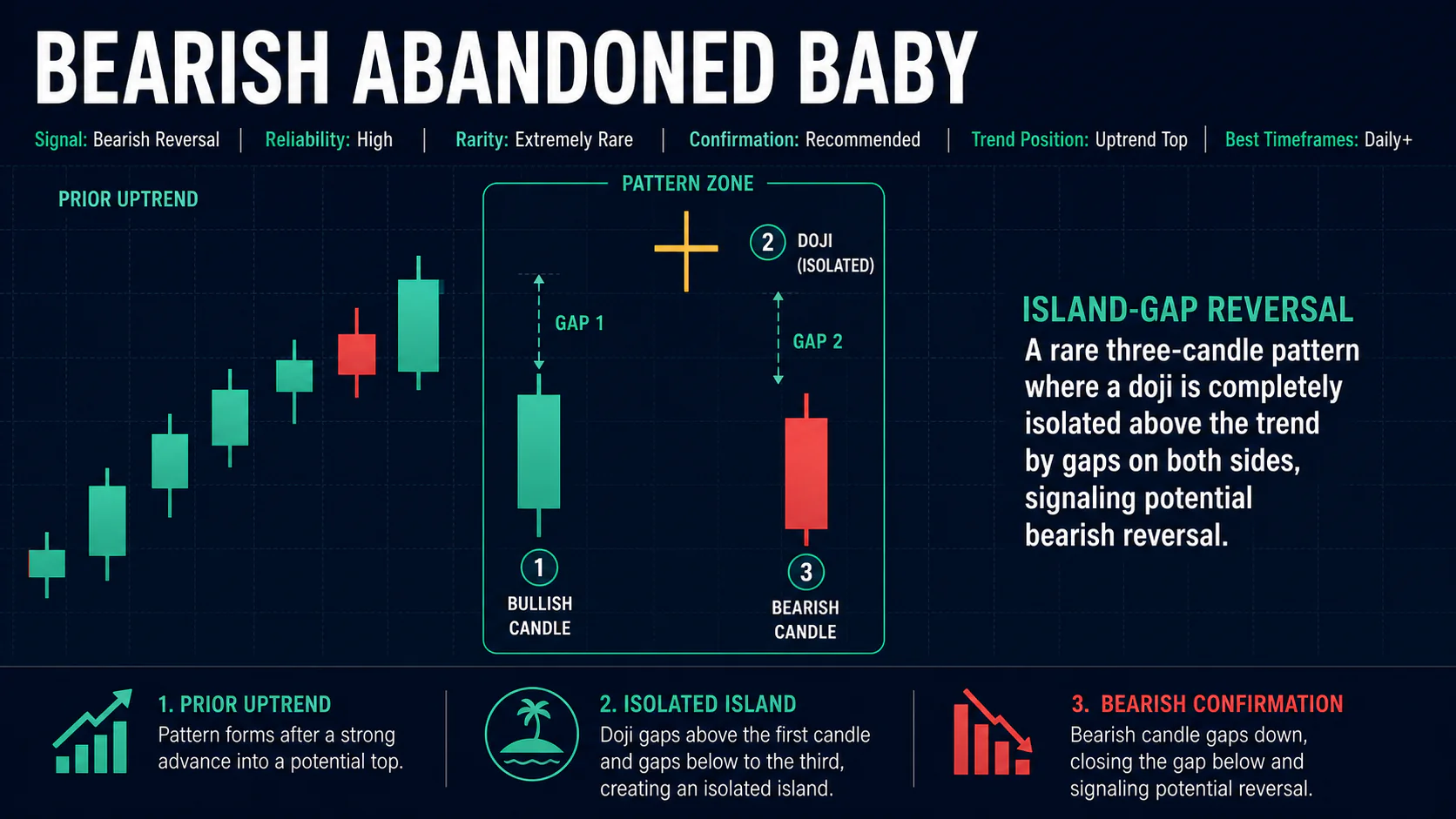
First candle: A strong bullish candle continuing the uptrend.
Second candle (the isolated doji): A doji that gaps above the first candle with no overlap between the two candles' shadows — the doji's low sits above the first candle's high.
Third candle: A strong bearish candle that gaps down from the doji, again with no shadow overlap, so the doji's low sits above the third candle's high as well.
Both gaps, including the shadow separation, are what distinguish this pattern from an ordinary evening doji star, where the gaps can be smaller or the shadows can touch. That strict island-gap requirement is exactly why the pattern is so rarely seen in practice.
Market Psychology
The first candle reflects late-stage bullish enthusiasm. The gap-up doji shows buyers still optimistic at the open, but the session resolves in complete equilibrium — a stall at a fresh high. The gap down on the third candle then shows an overnight reassessment: sentiment shifted sharply enough that no one was willing to trade the levels touched by the doji at all. That total abandonment of the recent high, expressed through two clean gaps rather than a gradual rollover, is what gives the pattern its reputation as a strong, if uncommon, reversal signal.
Trading the Pattern
Entry
Because the pattern is essentially self-confirming — the third candle's gap and strength already demonstrate the reversal — many traders act on the close of the third candle rather than waiting for a further session. More conservative traders can still wait for one additional bearish session before entering.
Stop Loss
Place stops above the doji's high. Since the pattern's gaps are meant to hold, a move back up through the doji invalidates the setup.
Profit Targets
Nearby support levels are reasonable initial targets. Given how rarely this exact pattern occurs, be cautious about relying on precise historical projections, and instead let subsequent price action confirm whether the decline is extending.
Combining With Indicators
The pattern is already considered strong on its own, but overbought readings on RSI or stochastics, a prior bearish MACD divergence, or formation at a major resistance level all add further support to the case.
Common Mistakes
- Calling ordinary gaps an "abandoned baby" when the shadows of adjacent candles actually overlap — the island-gap requirement is strict for a reason.
- Mistaking a small-bodied candle for a doji when the open and close aren't genuinely close together.
- Trading the pattern without an extended uptrend behind it.
- Oversizing positions on the assumption that rarity and reliability automatically justify it — sound risk management still applies.
FAQs
Why is the abandoned baby considered so rare?
It requires two separate gaps that don't overlap even in their shadows — a strict condition most doji-based patterns don't demand. That combination doesn't come together often.
How is it different from an evening doji star?
An evening doji star also has a gapping doji between a bullish and bearish candle, but the shadows of adjacent candles can touch or overlap. The abandoned baby specifically requires complete separation, including shadows, on both sides. See the related evening star pattern for the more common, less strict version of this family.
Do I still need confirmation if the pattern is self-confirming?
The third candle's gap and strength already provide meaningful confirmation, which is why some traders act on the close of that candle. More cautious traders can still wait for an additional session of follow-through.
What's the bullish equivalent?
The bullish abandoned baby, the same island-gap structure appearing at the bottom of a downtrend instead.
Conclusion
The bearish abandoned baby's rarity is a direct consequence of how strict its gap requirements are, and that strictness is also what makes it a credible reversal signal when it genuinely appears. Confirm the shadow separation carefully before labeling a pattern this way, and size the trade sensibly even though the setup is considered strong.