Bearish In Neck
Updated Aug 26, 2026
- Signal
- Bearish Continuation
- Reliability
- Moderate
- Rarity
- Common
- Confirmation
- Recommended
- Trend Position
- Downtrend
- Best Timeframes
- Daily+
On this page
The bearish in neck pattern is a two-candle continuation pattern found in downtrends. After a long black candle, a white candle opens below the prior low but closes just barely above the prior candle's close - only a shallow poke into its body. That marginal recovery is read as a failed bounce, and the downtrend is expected to continue.
Recognizing the Pattern
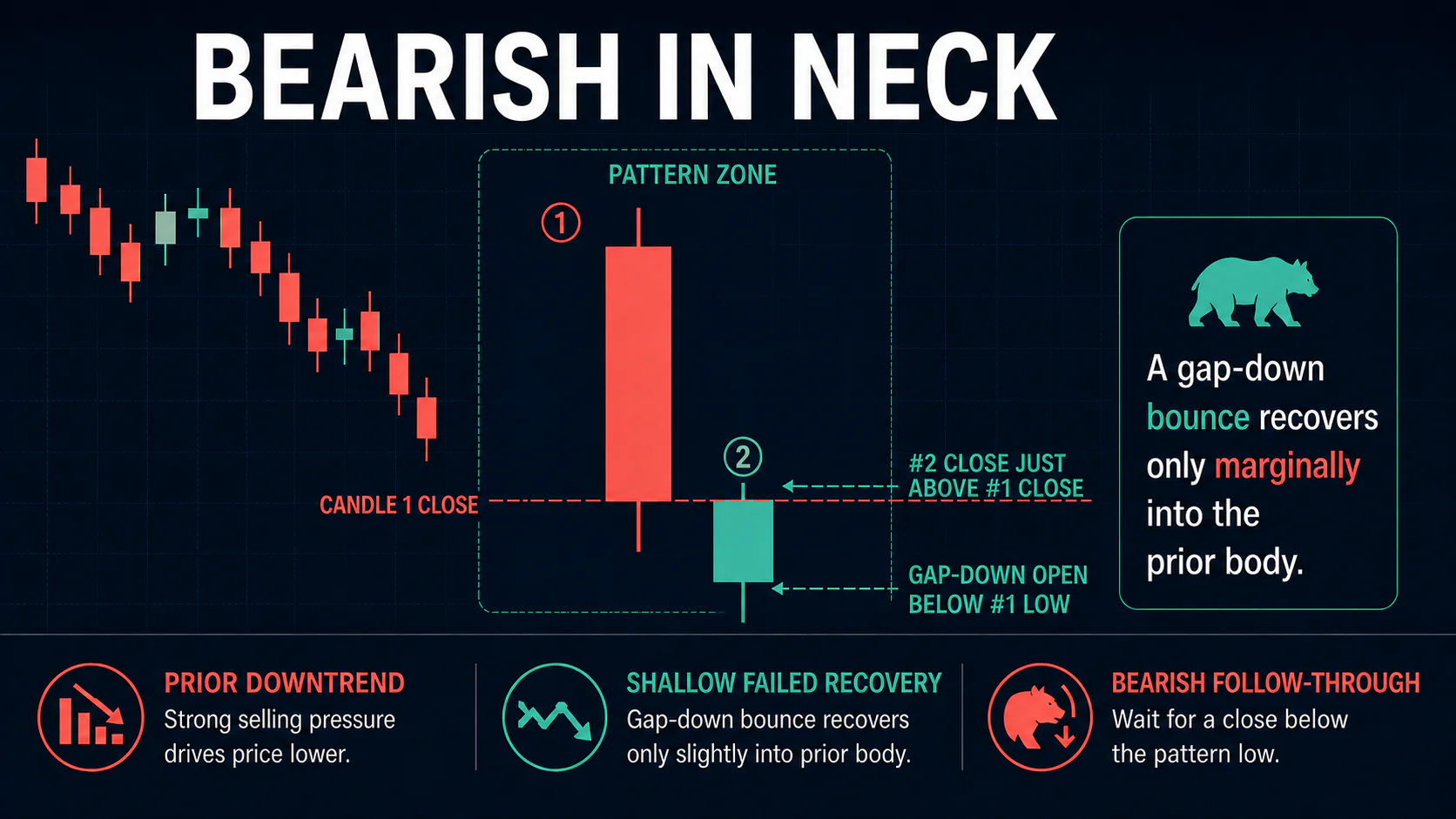
First candle: a long black candle with a substantial real body, showing sellers in firm control through the session.
Second candle: a white candle that opens below the first candle's low (a gap-down open), then rallies just enough to close a little above the first candle's close. The close should sit only marginally inside the black candle's body, near its bottom edge.
This shallow penetration is what separates in neck from its two close relatives. All three share the same setup - a long black candle followed by a gap-down white candle in a downtrend - and differ only in how far the second candle's close reaches into the first candle's body: on neck closes at or right around the prior low, the shallowest of the three; in neck closes just above the prior close, slightly deeper; and thrusting closes noticeably further into the body but still below its midpoint. A close above the midpoint would instead be a bullish piercing line, which changes the signal entirely.
The pattern only carries continuation meaning inside an established downtrend; the same two candles appearing in a sideways market or uptrend do not have the same implication.
Market Psychology
The first candle confirms sellers dominated the session from open to close. The gap-down open on the second candle shows selling pressure carrying into the next session, and while some buyers do step in, they only manage to push the close a hair above the prior candle's close. That is a weak result - real buying conviction would have driven the close meaningfully higher into, or above, the prior body. The shallow recovery suggests sellers are willing to defend even minor bounces, which is why the pattern is read as continuation rather than reversal. Traders who bought into the gap-down expecting a bigger bounce are often the ones selling into the next leg lower once the pattern completes.
Variations
The main variable within a valid in neck setup is how close the second candle's close sits to the first candle's close - the closer it hugs that level, the weaker the buying and the more convincing the continuation read. A second candle with a longer upper shadow, showing buyers pushed higher intraday before fading back down to the close, is a somewhat stronger version than one that closes near its own high. Beyond that, this is a narrowly defined pattern; most apparent variations are really just neighboring points on the on neck / in neck / thrusting spectrum described above.
Trading the Pattern
Entry: a short entry can be taken at the close of the second candle once the shallow penetration is confirmed, though many traders prefer to wait for the next session to open lower or otherwise confirm continued weakness.
Stop-loss: place stops above the high of the second candle - a sustained move above that level would suggest buyers are stronger than the pattern implies.
Targets: project the size of the first candle downward from the pattern's low for an initial target, then look to the next meaningful support level - prior lows, trendlines, or moving averages.
Confirmation
Given how shallow the second candle's recovery is, confirmation from the next session adds real value. A lower open or a close in the bottom half of the following session's range both support the pattern, while a strong follow-through rally back into the first candle's body should be treated as a sign the bounce has more strength than the pattern suggested.
Combining with Indicators
Lower volume on the second candle than the first supports the reading that the bounce lacked institutional participation. RSI holding below its midline or the MACD remaining negative through the pattern both add confidence, as does the setup forming beneath a moving average or a recently broken support level now acting as resistance.
Common Mistakes
The most common error is misjudging where the second candle actually closes - accepting a close that reaches too far into the first candle's body (which would make it thrusting, not in neck) or, conversely, one that barely clears the prior low (which is closer to on neck). Trading the pattern outside a clear downtrend, ignoring the volume relationship between the two candles, and skipping confirmation before entry are the other frequent mistakes.
FAQs
What is the difference between in neck and on neck?
Both are gap-down white candles in a downtrend, but on neck closes at or near the prior candle's low, while in neck closes slightly higher - just above the prior candle's close, a hair deeper into its body.
Is bearish in neck a reversal or continuation pattern?
It is a continuation pattern. It confirms that a downtrend is likely to persist, not that it is reversing.
How common is this pattern?
It appears fairly often on daily charts of trending stocks, since it only requires a long black candle followed by a gap-down open and a weak recovery.
Does the pattern need a gap to be valid?
Yes. The second candle opening below the first candle's low is part of the definition; without that gap-down open, the setup is a different, weaker formation.
Should I trade this pattern without confirmation?
It is safer not to. Because the pattern only marks a marginal seller edge, waiting for the next session to confirm continued weakness reduces the risk of acting on a pattern that resolves the other way.
How does in neck differ from thrusting?
Both begin with a long black candle and a gap-down white candle in a downtrend, but thrusting's close reaches much further into the first candle's body - just short of its midpoint - showing stronger, though still ultimately failed, buying pressure.
Conclusion
Bearish in neck adds a small but useful piece of evidence to a downtrend thesis: a bounce attempt that barely dented the prior session's selling. It works best as confirmation alongside broader trend and volume context, not as a signal to trade in isolation.