Bearish Kicking
Updated Aug 26, 2026
- Signal
- Bearish Reversal
- Reliability
- High
- Rarity
- Rare
- Confirmation
- Recommended
- Trend Position
- Uptrend Top
On this page
The bearish kicking pattern is a two-candle reversal pattern built from two marubozu candles - candles with little or no shadows. A bullish marubozu is followed by a gap down into a bearish marubozu, with no overlap between the two bodies. The abrupt, shadowless gap is read as a sudden and decisive shift from buying to selling.
Recognizing the Pattern
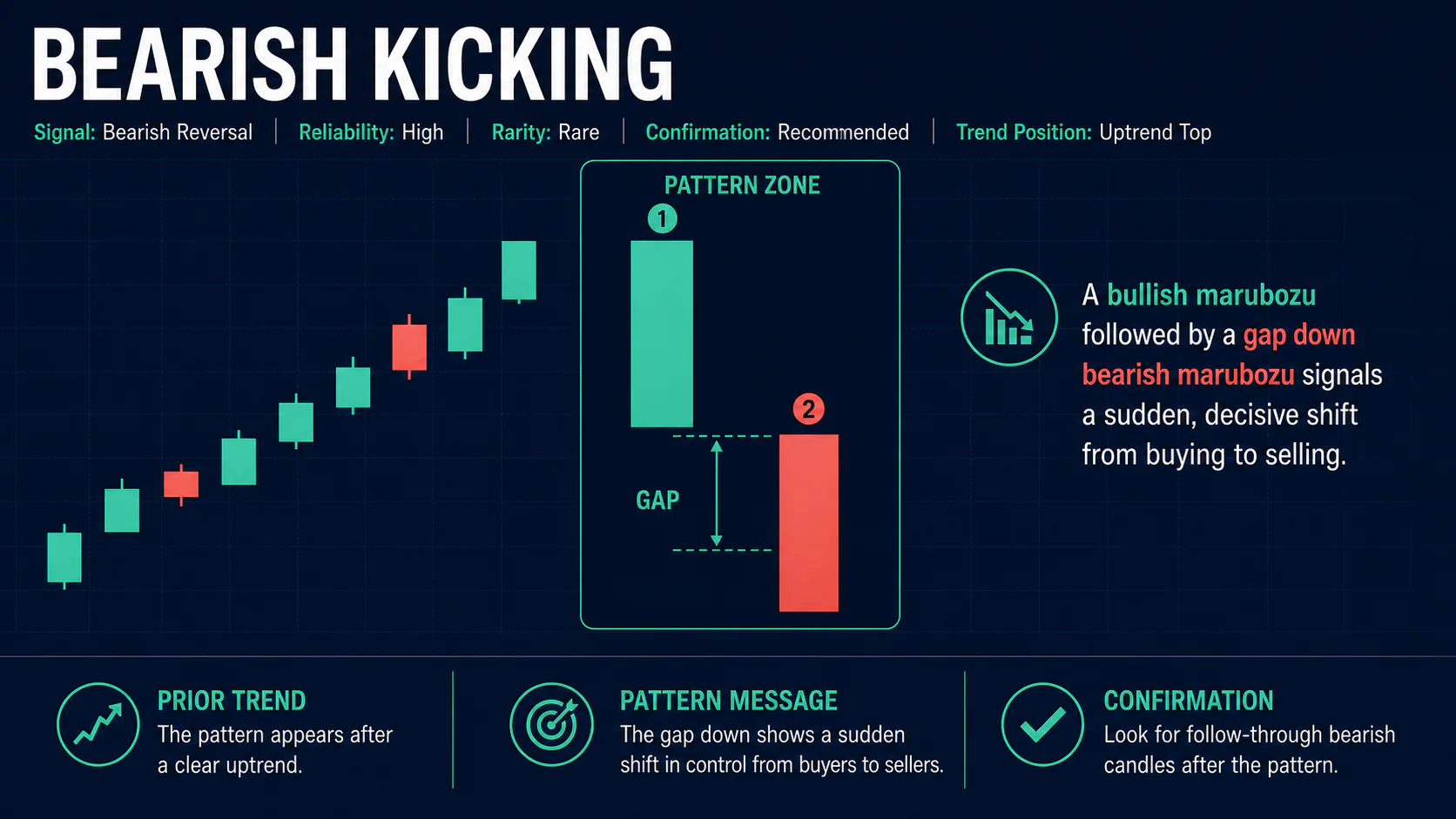
First candle: a bullish marubozu - a long white candle that opens at (or very near) its low and closes at (or very near) its high, with little to no shadow on either end.
Second candle: a bearish marubozu that gaps down below the first candle's low, opening at or near its own high and closing at or near its own low, again with little to no shadow.
No overlap: the bodies of the two candles must not overlap at all - the gap is what makes the pattern, not just a lower close.
The marubozu requirement matters: because neither candle has meaningful shadows, both sessions show one side in complete control from open to close, with none of the back-and-forth a shadow would represent. That is part of why the pattern is regarded as a strong, if rare, reversal signal - the gap represents a clean, unambiguous shift in sentiment rather than a gradual one. The pattern should appear after a clear uptrend to carry reversal meaning.
Market Psychology
The first candle's marubozu structure shows buyers in full control for the entire session, with the close at the high suggesting no hesitation about further gains. The gap down on the second candle is a sharp overnight reversal in sentiment, often tied to unexpected news, and the marubozu structure of that candle shows sellers then controlling the entire following session just as completely. Because there is no overlap between the two bodies, there is no price level where the two sides actually traded against each other - the market simply reset lower, which is why the pattern is read as decisive rather than gradual.
Variations
A larger gap between the two marubozu candles produces a more forceful version of the pattern, since it represents a bigger overnight shift with no chance for buyers and sellers to negotiate at intermediate prices. Occasionally one or both candles carry a whisper of a shadow rather than being perfectly shadowless - this is usually still treated as a valid kicking pattern as long as the shadows are minimal and the two bodies still do not overlap, though a textbook marubozu on both sides is the strongest form.
Trading the Pattern
Entry: more aggressive traders enter short on the gap-down open itself; more conservative traders wait for the second candle to close, confirming it held its marubozu structure without filling the gap.
Stop-loss: place stops above the first candle's high (or just above the gap for very aggressive entries) - any meaningful move back into the gap would undermine the pattern.
Targets: project the size of the gap downward from the second candle's low for an initial target, then look toward the next significant support level.
Confirmation
The clearest confirmation is simply that the gap does not fill in the sessions that follow. Elevated volume on the second candle supports genuine institutional participation in the reversal, and continued selling over the next few sessions adds further weight to the reversal thesis.
Combining with Indicators
RSI or stochastic readings that were overbought ahead of the gap add supporting context, as does the pattern forming at a known resistance level or beneath a key moving average.
Common Mistakes
Treating any gap-down reversal candle as a kicking pattern is the most common error - both candles need to be true marubozu with minimal shadows, not just long-bodied. Trading small, easily-filled gaps as if they carry the same weight as a large, clean gap is another mistake, as is ignoring what happens if the gap starts to fill, which should be treated as a warning sign regardless of position size. Compare with the mirror-image bullish kicking pattern to see the same logic applied at the bottom of a downtrend.
FAQs
What is a marubozu candle?
A marubozu is a candle with little to no upper or lower shadow, meaning the open and close sit at or very near the session's high and low. It signals one side controlled the entire session.
Why does the pattern require no overlap between the two candles?
The lack of overlap is what makes the gap real rather than just a lower close. It shows there was no price level where buyers and sellers actually traded against each other between the two sessions.
Is bearish kicking rare?
Yes. Two consecutive marubozu candles with a clean gap between them, and no overlap, is an uncommon combination.
What invalidates the pattern?
If the second candle's session trades back up into the first candle's range and fills the gap, the pattern's reversal logic no longer holds.
Does bearish kicking need to appear at a resistance level?
It is not required, but a pattern that forms at or near a known resistance level generally carries more weight than one appearing in open space.
How is bearish kicking different from bearish breakaway?
Kicking is a fast, two-candle gap reversal built from marubozu candles with an immediate sentiment flip. Bearish breakaway is a slower, five-candle process where the uptrend stalls for a few sessions before the reversal candle appears.
Conclusion
Bearish kicking is one of the more visually unambiguous reversal patterns because both candles are marubozu and the gap between them has no overlap at all. That structural cleanliness is what gives the pattern its reputation for reliability, though its rarity means confirmation and gap-fill monitoring still matter.