Bearish Dragonfly Doji
Updated Aug 26, 2026
- Signal
- Bearish Reversal (Context-Dependent)
- Reliability
- Low
- Rarity
- Common
- Confirmation
- Required
- Trend Position
- Uptrend Top
On this page
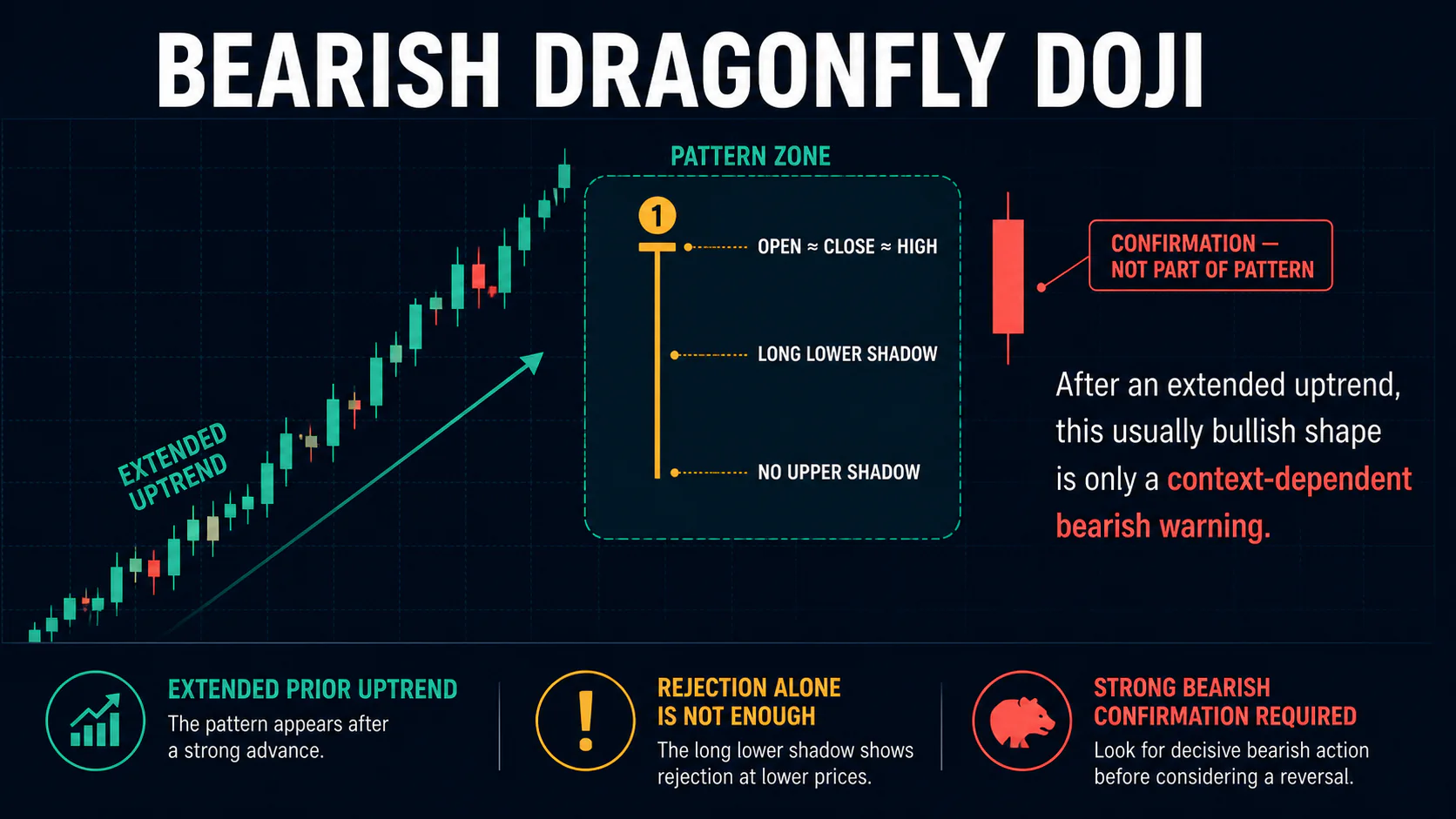
A dragonfly doji has a small body at the top of its range, with a long lower shadow and little or no upper shadow — open, close, and high are all close together while price dipped sharply intraday before recovering. In its standard, textbook use, a dragonfly doji is a bullish signal: appearing after a decline, it shows sellers pushed price lower only for buyers to reclaim the session, a pattern closely related to the hammer. This article covers that same shape appearing instead after an uptrend, where a minority of technicians read it as a bearish warning — a less common and less reliable interpretation that needs strong confirmation before it means anything.
The Conventional Reading: Bullish
Classic candlestick literature treats the dragonfly doji as a bottom-reversal signal. After a downtrend, it shows that although sellers drove price to a new low during the session, buyers fully reclaimed that ground by the close — the same logic behind a hammer. If you're looking for the standard, well-supported use of this shape, see the bullish dragonfly doji.
The Bearish Variant: Context-Dependent
Some traders apply the same shape to uptrends, arguing that any doji — including one with a long lower shadow — signals indecision, and indecision at a market top can precede a reversal. The reasoning is weaker here than in the bullish case: the pattern still shows buyers defending the lows and pushing the close back up, which could just as easily be read as bullish even in an uptrend. Because the textbook case for a bearish reading is thin, treat this interpretation as speculative and always wait for confirmation from the following session before acting on it.
Recognizing the Pattern
Doji structure: Open and close are equal or virtually equal, positioned at or near the top of the session's range.
Long lower shadow: Price traded well below the open before recovering — the longer this shadow relative to the body, the more pronounced the pattern.
Minimal upper shadow: Little to no wick above the body, showing the open/close level was also near the session high.
Trend context: For the bearish reading specifically, the pattern needs to appear after a clear, extended uptrend; in a downtrend the same shape reverts to its standard bullish interpretation.
Market Psychology
Within the session, sellers push price down, then buyers step back in with enough force to erase the loss and close near the open. In an uptrend, that recovery could just as easily be read as bulls defending their trend — which is exactly why the bearish interpretation is contested. The argument for bearishness rests on the idea that the inability to close higher than the open, despite the intraday dip being fully recovered, shows upside momentum losing steam even while support holds. It's a subtler and weaker signal than a gravestone doji or shooting star, both of which show outright rejection of higher prices.
Trading the Pattern
Entry
Never trade the bearish read off the dragonfly doji alone. Wait for the next session to close meaningfully below the doji's low, ideally on a gap down, before considering a short entry.
Stop Loss
Place stops above the doji's high. Because the base signal is weak, keep position size modest relative to higher-conviction setups like a gravestone doji or bearish engulfing pattern.
Profit Targets
Favor nearby support levels over ambitious downside projections — the pattern's weak theoretical basis argues for conservative targets and a willingness to exit quickly if follow-through doesn't appear.
Combining With Indicators
Given how speculative the bearish reading is on its own, confluence matters more here than with most patterns. Look for the doji to form at a well-established resistance level, with RSI or stochastic readings in overbought territory and ideally a bearish MACD divergence already underway. Absent that context, treat an uptrend dragonfly doji as background noise rather than a signal.
Common Mistakes
- Assuming a dragonfly doji is automatically bearish just because it appears after a rally — the conventional reading of this shape is bullish, and that logic doesn't fully disappear just because of trend context.
- Skipping confirmation, which is especially risky here given how thin the bearish case already is.
- Confusing a dragonfly doji with a gravestone doji — the two have opposite shadow structures, and the gravestone is the pattern with genuine textbook support for a bearish read at tops.
- Sizing the trade as if it were a high-reliability setup rather than the speculative, context-dependent read that it actually is.
FAQs
Is a dragonfly doji bullish or bearish?
Conventionally bullish. It's a recognized bottom-reversal signal when it appears after a decline. Reading it as bearish requires it to appear after an uptrend, and even then the interpretation is a minority view that needs strong confirmation.
Why do some traders call it bearish at all?
Because any doji reflects indecision, and indecision after a long advance can precede a top. The argument is weaker than for patterns built specifically around upside rejection, like the gravestone doji or shooting star.
What's the "real" bearish counterpart to the dragonfly doji?
The gravestone doji, which has the opposite shadow structure — a long upper shadow and minimal lower shadow — and is the textbook bearish top signal.
Do I need confirmation to trade this pattern?
Yes, always, and more so than with most reversal candles, given how contested the bearish interpretation is.
Conclusion
The dragonfly doji's well-established use is bullish. Reading it as bearish after an uptrend is a secondary, context-dependent interpretation that most classic technical analysis literature treats with skepticism. If you choose to trade it that way, demand strong confirmation, keep size modest, and recognize that a gravestone doji or shooting star makes a much stronger case for a top than a dragonfly doji ever will.