Bearish Evening Star
Updated Aug 26, 2026
- Signal
- Bearish Reversal
- Reliability
- High
- Rarity
- Moderate
- Confirmation
- Recommended
- Trend Position
- Uptrend Top
On this page
A bearish evening star is a three-candle reversal pattern that can appear at the top of an uptrend. The first candle is a long bullish candle continuing the trend; the second is a small-bodied "star" that gaps away from the first candle, showing indecision; the third is a strong bearish candle that closes well back into the first candle's body. The sequence — strength, indecision, reversal — is why the pattern is regarded as one of the more dependable three-candle top signals, though confirmation still strengthens the case.
Recognizing the Pattern
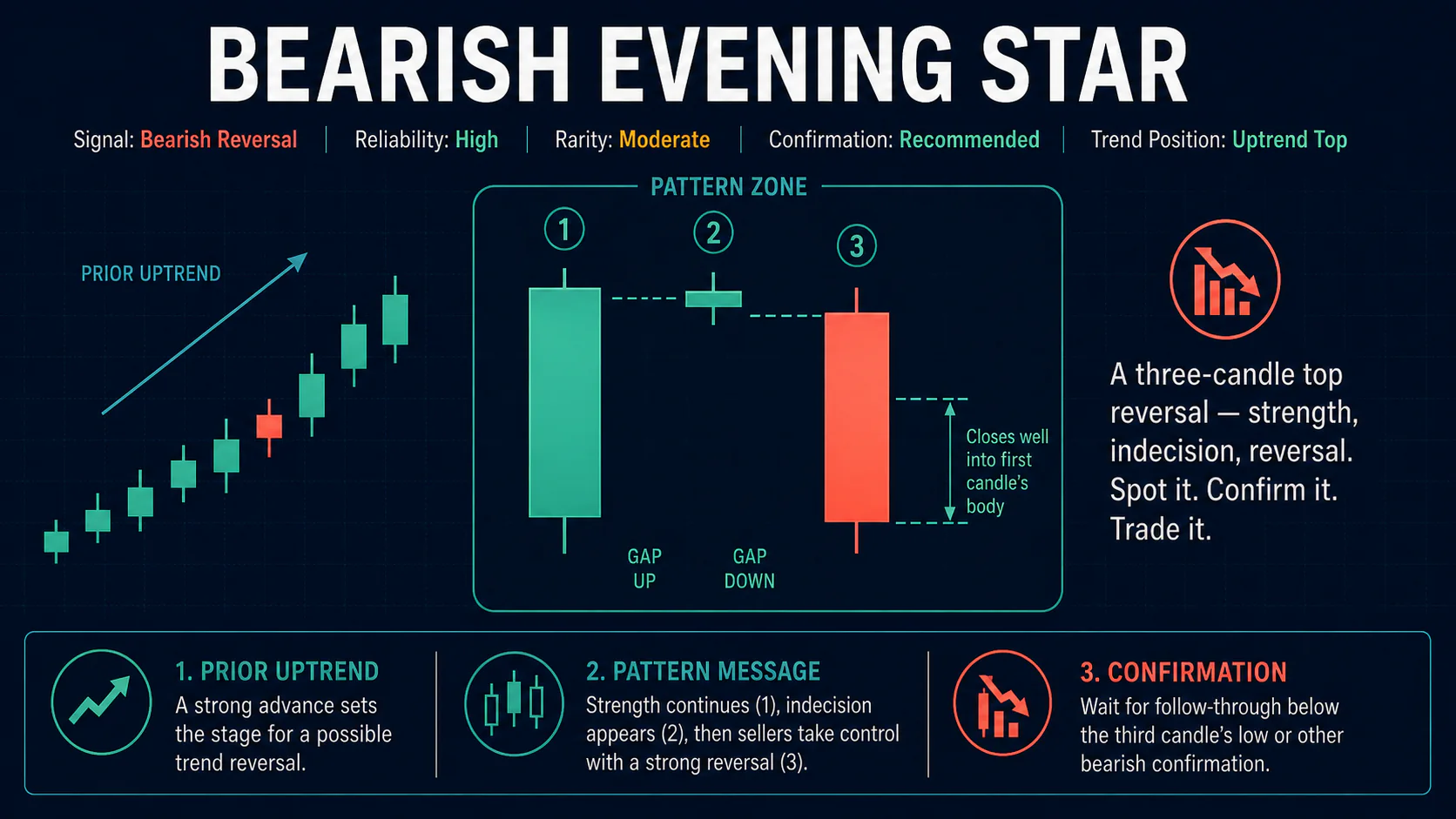
- First candle: a long bullish candle with a substantial real body, continuing the prevailing uptrend.
- Second candle (the star): a small-bodied candle — bullish, bearish, or a doji — that gaps above the first candle's close. Its small body relative to the first candle is what signals indecision.
- Third candle: a bearish candle that closes well into the first candle's real body, ideally at least halfway.
- Context: needs a genuine uptrend beforehand for the reversal reading to apply.
Gaps on both sides of the star — between the first and second candles, and between the second and third — add to the pattern's visual clarity and are considered ideal, though a small-bodied second candle with minimal overlap can still function as a valid star even without a clean gap. A third candle that closes near its own low, on noticeably higher volume, is a stronger confirmation of the reversal than one that closes only modestly lower.
Like other multi-candle patterns, an evening star can form on any timeframe, but it's most often referenced on daily charts, where each of the three candles represents a full session's worth of trading. The same three-candle sequence on a weekly chart, following a long and well-established advance, generally carries more weight than an identical shape on a short intraday chart.
Market Psychology
The first candle shows buyers firmly in control, extending the uptrend with conviction. The second candle's small body, despite gapping to a new high, shows that conviction stalling — buyers and sellers are now roughly balanced, and the market can no longer easily push higher. The third candle resolves that standoff decisively in favor of sellers, closing back into territory the first candle had claimed. That three-part sequence — confidence, hesitation, reversal — is a clear and intuitive picture of a trend running out of buyers.
Variations
- Doji evening star: the middle candle is a true doji rather than just a small body, sharpening the indecision signal. This variant is covered separately as the evening doji star.
- Evening star with clean gaps: gaps appear on both sides of the star candle, which most technicians treat as the strongest form of the pattern.
- Evening star at resistance: the same three-candle shape forming at a known resistance level or major moving average adds independent technical weight.
- Volume-confirmed evening star: healthy volume on the first candle, a quiet star, and a clear pickup in volume on the third candle — a sequence that suggests the reversal reflects a genuine change in participation rather than a lull.
Trading the Evening Star
Entry: Conservative traders wait for the third candle to close below the midpoint of the first candle before entering short. More aggressive traders enter intraday once the third candle breaks below the first candle's low.
Stop-loss: Above the star's high is a reasonably tight placement; above the first candle's high is more conservative and gives the trade more room.
Targets: Nearby support levels below the pattern are the most realistic near-term goal. A projection measuring the distance from the first candle's high down to the third candle's low, applied downward from the breakdown point, offers a rough guide for a larger move.
Confirmation
The third candle itself functions as confirmation of the star's indecision, but some traders still want to see a fourth session continue lower, or a break of nearby support, before committing. Volume expansion on the third candle relative to the star adds meaningful confidence that broader selling, not just light trading, is driving the reversal.
Combining with Technical Indicators
The pattern carries more weight when RSI is above 70 with bearish divergence, when MACD shows deteriorating momentum into the pattern, or when the setup coincides with a major resistance level or moving average. Weakness in the surrounding sector or broader market at the same time adds further supporting context.
Common Mistakes
- Trading it without sufficient uptrend context — the pattern needs a real advance behind it to carry reversal meaning.
- Accepting a star that isn't meaningfully smaller than the surrounding candles, diluting the indecision signal.
- Accepting shallow penetration on the third candle rather than requiring a close well into the first candle's body.
- Entering before the third candle closes, before the pattern is actually complete.
- Treating every evening star the same regardless of how deep the third candle closes or how the pattern lines up with resistance.
Where It Fits in a Trading Plan
An evening star's three-candle structure already builds in a form of confirmation — the pattern isn't complete until the third candle closes — but that doesn't make it infallible. It works best when treated as one signal within a broader plan: knowing where support and resistance sit before the pattern forms, checking whether momentum indicators already look stretched, and sizing any resulting trade so that a stop above the pattern's high is a small, planned loss rather than a large one. Because even a textbook evening star can fail to produce a lasting reversal, keeping a record of how the pattern has performed on a given stock or index is a practical way to judge how much confidence future occurrences deserve.
FAQs
What's the difference between an evening star and an evening doji star?
Only the middle candle. A regular evening star has any small-bodied candle as its star; an evening doji star requires that middle candle to be a true doji, which many traders consider a stronger indecision signal.
What's the bullish opposite of the evening star?
The morning star — the same three-candle structure appearing after a downtrend instead of an uptrend, signaling a possible bottom rather than a top.
Do the gaps have to be present for the pattern to be valid?
Gaps make the pattern cleaner and are considered ideal, but many practitioners will still accept the pattern with minimal overlap instead of a clean gap, provided the star's body is genuinely small relative to the outer candles.
How far does the third candle need to close into the first candle?
Deeper is stronger. A close at or beyond the midpoint of the first candle's body is the generally accepted threshold for a valid, tradeable pattern.
Does the evening star need confirmation?
The third candle already provides much of the confirmation built into the pattern's own definition, but additional follow-through in the next session or two increases confidence further.
Can the evening star form without any gaps at all?
It's less textbook without gaps, but many practitioners will still count a three-candle sequence as a workable evening star if the star candle's body is genuinely small and sits near the top of the recent range, even when the surrounding candles don't leave a clean gap on either side.
Conclusion
The bearish evening star lays out a trend reversal in three readable steps: continued strength, a stall, and then a decisive reversal back into the prior gains. Its reliability improves with clean gaps, a genuinely small star candle, deep penetration by the third candle, and formation at a resistance level. As with any pattern, treat it as one input among several rather than a standalone trigger.