Bearish Doji Star
Updated Aug 26, 2026
- Signal
- Bearish Reversal
- Reliability
- Moderate
- Rarity
- Common
- Confirmation
- Required
- Trend Position
- Uptrend Top
On this page
A bearish doji star is a two- or three-candle warning pattern that appears after an uptrend. A strong bullish candle extends the advance, then a doji opens with a gap above that candle's high, showing that buyers and sellers reached a rough balance at an elevated price. The pattern is a caution flag rather than a confirmed reversal — traders generally wait for a bearish candle on the next session to confirm that sellers have actually taken control.
Recognizing the Pattern
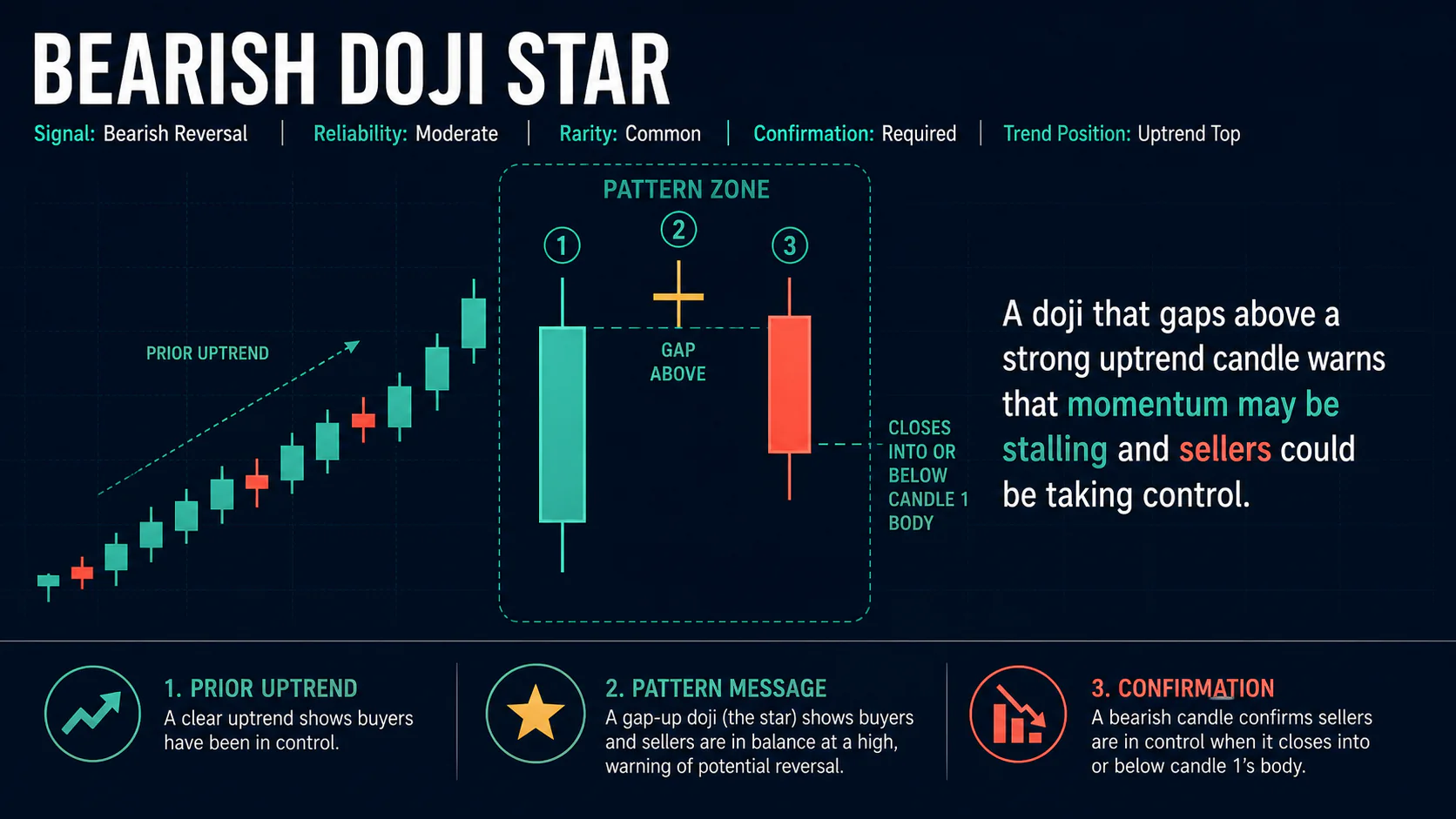
First candle: A long bullish candle that continues the established uptrend, showing buyers still in control.
Second candle (the star): A doji — open and close virtually identical — that gaps above the first candle's high. The gap and the doji's small body together create the "star" appearance sitting apart from the prior trend.
Third candle (confirmation): A bearish candle that closes back into or below the first candle's body. When this candle also gaps down from the doji, the completed three-candle version is often called an evening doji star, a more decisive variant of the same idea.
For the pattern to mean anything, it needs a genuine prior uptrend — a doji star appearing in a sideways or choppy market carries little signal value.
Market Psychology
The sequence tells a straightforward story of fading conviction. The first candle reflects buyers still pushing prices higher. The gap-up doji shows that even though the session opened higher still, it ended in a stalemate — an early sign that upward momentum may be running out. Neither candle by itself proves anything; it's the failure of buyers to follow through on the gap that raises the possibility of a top. The third, bearish candle is what actually shifts control to sellers — before it appears, the pattern is only a warning.
Variations
Evening doji star: The fully confirmed, three-gap version — bullish candle, gap-up doji, gap-down bearish candle closing below the first candle's midpoint. This is the strongest form of the pattern.
Gravestone or dragonfly doji star: When the middle doji itself has a long upper shadow (gravestone-like) or long lower shadow (dragonfly-like), it adds a secondary signal on top of the star formation, though the core interpretation doesn't change.
Trading the Pattern
Entry
Most traders wait for the close of the third, confirming candle before entering short, since the doji alone doesn't establish that sellers are in control. A close of the third candle below the doji's low, ideally on a gap down, is the cleanest signal.
Stop Loss
A logical stop sits above the doji's high, or the high of the whole three-candle pattern — a move back above that level undermines the bearish read entirely.
Profit Targets
Nearby support levels make reasonable first targets. More aggressive traders sometimes project the size of the first candle downward from the pattern's low, but any such projection is a rough guide, not a guarantee.
Confirmation and Context
The pattern is materially stronger when it forms at a recognizable resistance level, a round number, or a major moving average, and when broader momentum indicators are stretched. Without that context, treat it as a caution sign rather than a trade trigger.
Combining With Indicators
An RSI reading in overbought territory (commonly above 70), a bearish MACD crossover, or an overbought stochastic reading occurring alongside the pattern all add some weight to the bearish case. None of these are required, but a doji star that coincides with several of them is more worth taking seriously than one appearing in isolation.
Common Mistakes
- Entering on the doji itself instead of waiting for the confirming third candle.
- Treating a small-bodied candle with a large gap as a doji when the open and close aren't actually close together.
- Ignoring the trend requirement — trading the pattern in a flat or already-declining market where it has no reversal context.
- Setting stops too tight given normal volatility, leading to being stopped out before the move develops.
FAQs
Is a doji star by itself a sell signal?
No. On its own, the gap-up doji is only a warning that momentum may be stalling. Most traders treat the pattern as complete, and tradeable, only after a bearish third candle confirms it.
What's the difference between a doji star and an evening star?
An evening star uses a small-bodied candle, not necessarily a doji, in the middle position. When that middle candle is specifically a doji, the pattern is called a doji star, and the fully gapped three-candle version is an evening doji star.
Does the gap have to be a true price gap?
Ideally yes, since the gap is what isolates the doji and creates the "star" visual. Stocks and indices gap more often around the open than instruments that trade continuously, so the pattern is easier to find on daily stock and index charts.
How reliable is this pattern?
It's a widely recognized warning pattern, but like all candlestick signals it works best as one input alongside trend context, support and resistance, and momentum indicators — not as a standalone system.
Conclusion
The bearish doji star captures a clear shift in market behavior: strong buying, followed by stalemate, followed — if confirmed — by seller control. Its value lies in that structure rather than in any precise success rate. Wait for the confirming candle, respect the invalidation level above the pattern, and weigh the setup more heavily when it lines up with resistance or overbought readings elsewhere.