Bearish Meeting Lines
Updated Aug 26, 2026 · Reviewed by Terence Scott, founder
- Signal
- Bearish Reversal
- Reliability
- Moderate
- Rarity
- Rare
- Confirmation
- Recommended
- Trend Position
- Uptrend Top
- Best Timeframes
- Daily+
On this page
Bearish meeting lines are a two-candle reversal pattern that can appear near the top of an uptrend. A bullish candle closes at a given price, then the next session gaps up but sells off all day to close at that same price. The matching closes show buyers and sellers converging at one level, with sellers ultimately gaining the upper hand.
Recognizing the Pattern
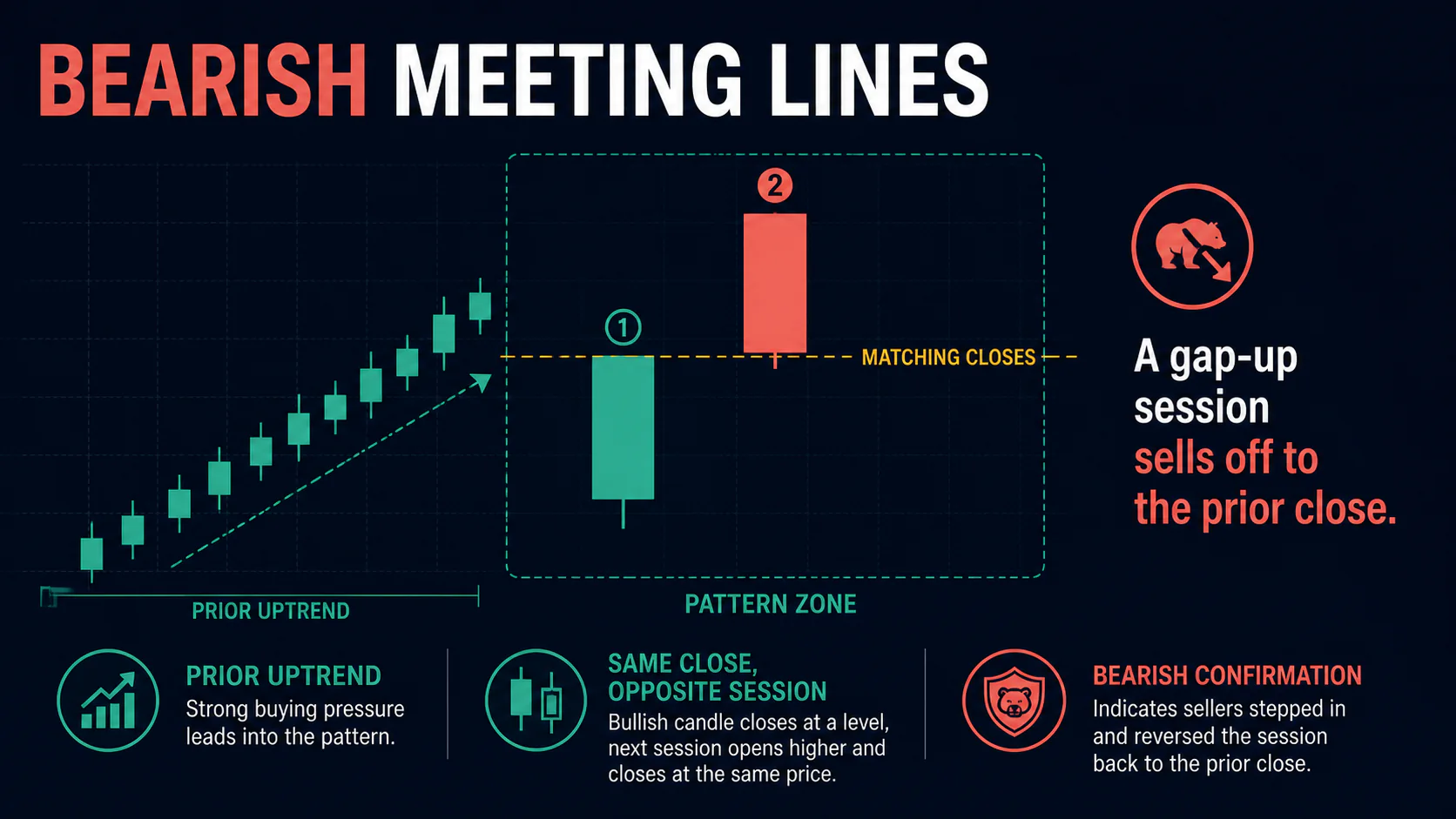
First candle: a white (or green) candle that closes with positive momentum, typically continuing an existing uptrend.
Second candle: a black (or red) candle that opens with a gap above the first candle's close, then declines through the session to close at essentially the same price as the first candle's close.
The defining feature is the matching close, not a matching open - this is what distinguishes meeting lines from separating lines, which share an opening price instead. Both candles should have meaningful real bodies rather than doji-like indecision, and the pattern is most significant when it appears after a genuine uptrend, ideally near a resistance level.
Market Psychology
The first candle reflects continued buyer confidence and an expectation of further gains. The gap-up open on the second candle initially extends that optimism, but sellers emerge and gradually take control through the session, eventually erasing the entire gap and the day's gains to land right back at the prior close. That identical close creates a visible ceiling: it shows that despite an optimistic open, the market could not sustain any net progress above the prior session's level, which is often read as a sign the buying is running out of conviction.
Variations
A larger gap on the second candle's open makes for a more dramatic version of the pattern, since more early optimism is subsequently erased. Occasionally the second candle's decline is gradual and orderly rather than sharp, which still satisfies the pattern as long as the close lands back at the first candle's level; a sharper, faster decline is generally read as the stronger of the two forms.
Trading the Pattern
Entry: given the pattern's rarity and only moderate reliability, most traders wait for a following session that closes below the meeting-line level before entering short.
Stop-loss: place stops above the high of the second (bearish) candle; a move back above that level undercuts the reversal thesis.
Targets: project the average height of the two candles downward from the meeting-line level for an initial target, then look to the next meaningful support level.
Confirmation
Higher volume on the second candle than the first supports the reversal read, since it suggests the selling that erased the gap had real participation behind it. The clearest confirmation is a following session that closes below the meeting-line level rather than simply retesting it.
Combining with Indicators
RSI showing overbought readings ahead of the pattern, or the meeting-line level lining up with a prior resistance level or moving average, both add useful confluence.
Common Mistakes
Accepting closes that only roughly match, rather than verifying they are effectively identical, is the most common recognition error - the exact convergence is what gives the pattern its meaning. Trading it in a sideways market rather than after a genuine uptrend, skipping the gap-up requirement on the second candle, and entering before a confirming session closes below the meeting-line level are the other frequent mistakes.
FAQs
How is bearish meeting lines different from bearish separating lines?
Meeting lines share a matching close between the two candles; separating lines share a matching open instead. The two patterns look similar but signal from opposite ends of the candles.
Is this a common pattern?
No, it is relatively rare, since it requires the second candle's close to land almost exactly on the first candle's close after a gap-up open.
Does the second candle need to gap up?
A gap-up open is the classic form and gives the pattern its clearest psychological read, though the matching closes are the essential feature.
What confirms a meeting lines reversal?
A following session that closes below the shared meeting-line level, ideally with expanding volume, is the standard confirmation traders look for.
Where does the pattern work best?
It is most meaningful when it forms near a resistance level or after an extended uptrend, where the failed advance carries more weight than it would in a flat or choppy market.
Is bearish meeting lines the same as a bearish engulfing pattern?
No. A bearish engulfing candle closes below the first candle's open, fully swallowing its body; meeting lines instead closes at the same level as the first candle's close, a much narrower and more specific convergence.
Conclusion
Bearish meeting lines mark a session where an optimistic gap-up open was completely unwound, leaving buyers and sellers at a standstill that tipped in the sellers' favor. Given its rarity and moderate reliability, the pattern is best traded with confirmation and modest position sizing.