Bearish Thrusting
Updated Aug 26, 2026 · Reviewed by Terence Scott, founder
- Signal
- Bearish Continuation
- Reliability
- Moderate
- Rarity
- Common
- Confirmation
- Recommended
- Trend Position
- Mid-Trend
- Best Timeframes
- Daily+
On this page
The bearish thrusting pattern is a two-candle continuation pattern that forms in a downtrend. A long black candle is followed by a white candle that gaps down at the open, then rallies to close inside the black candle's body - but still below its midpoint. That failure to reach the midpoint is read as evidence the downtrend still has control.
Recognizing the Pattern
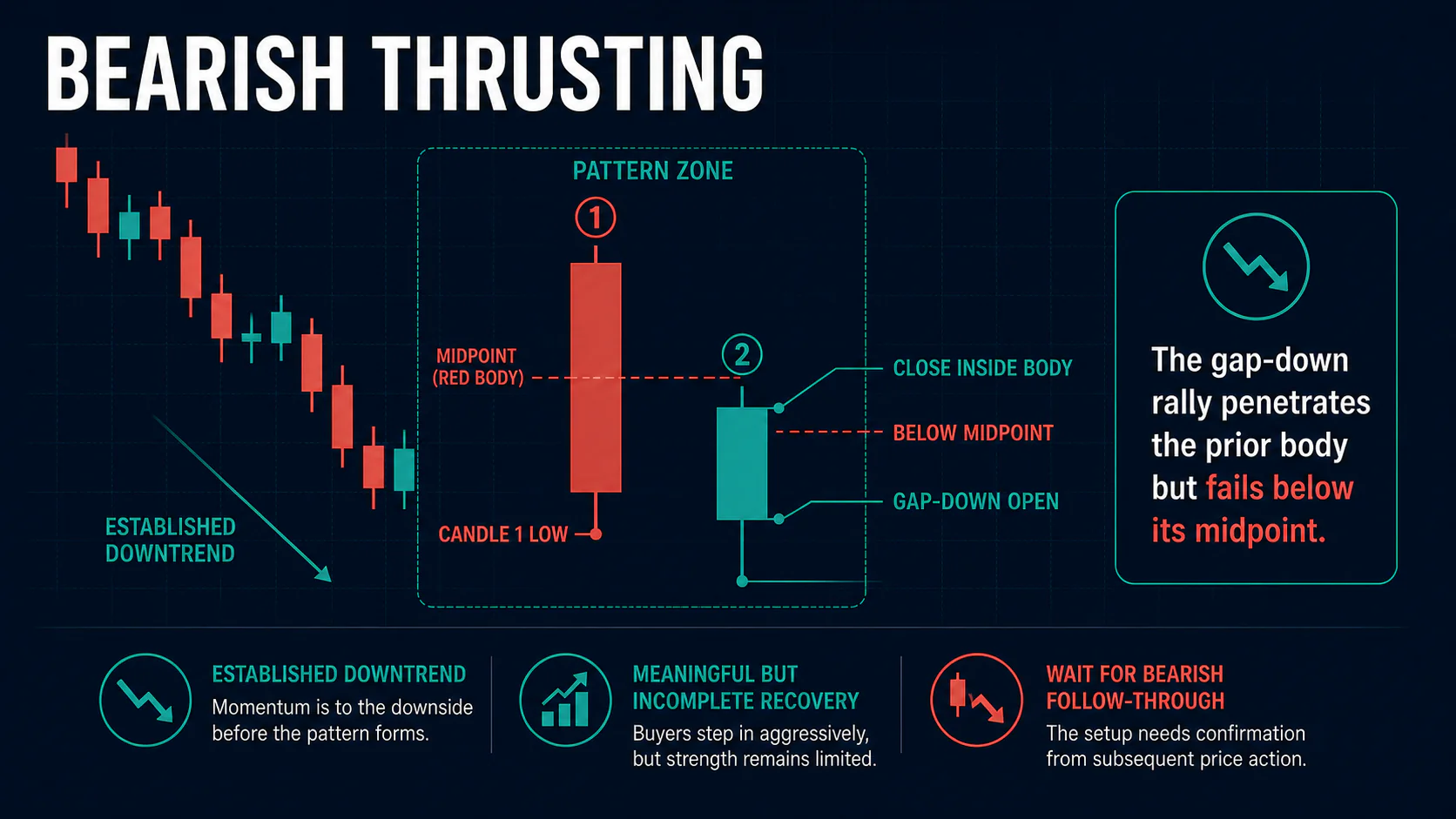
First candle: a substantial black candle, ideally larger than the recent average range, showing decisive selling.
Second candle: a white candle that opens with a gap down - below the first candle's low or at least below its close - then rallies to close within the first candle's body, but below its midpoint. The midpoint is simply the average of the first candle's open and close.
Thrusting sits in the middle of the same three-pattern family as on neck and in neck: all three begin with a long black candle followed by a gap-down white candle in a downtrend, and the only distinction is how far the second candle's close reaches into the first candle's body. On neck closes at the prior low, in neck closes just above the prior close, and thrusting closes further still - clearly inside the body - but always below the midpoint. If the close moves above the midpoint instead, the pattern becomes a bullish piercing line, a reversal signal rather than a continuation one, so the midpoint is the line that separates the two interpretations.
Market Psychology
The long first candle establishes clear selling dominance. The gap-down open on the second candle continues that theme overnight, and the subsequent rally shows genuine buying interest - more than in on neck or in neck - but it still falls short of reclaiming half of the prior session's losses. That failure at the midpoint indicates sellers remain able to absorb buying pressure without losing control, even though the buying here is stronger than in the shallower versions of this pattern. Because the contest is closer than in its two relatives, thrusting is often seen as the last meaningful test of a downtrend before a genuine reversal pattern like a piercing line would take over.
Variations
A second candle that closes just below the midpoint is a marginal thrusting pattern and deserves more caution, since a slightly stronger session could tip it into a bullish piercing line instead. A second candle that closes well below the midpoint, closer to the first candle's close, is a more convincing continuation signal, since the buying attempt clearly fell well short despite real effort intraday.
Trading the Pattern
Entry: enter short once the second candle closes below the midpoint, ideally with confirmation from the following session continuing lower.
Stop-loss: place stops above the second candle's high, or above the first candle's midpoint for a tighter but more easily triggered stop.
Targets: project the first candle's range downward from the pattern's low for an initial target, then look to the next meaningful support level.
Confirmation
Because thrusting shows more buying effort than on neck or in neck, confirmation matters more here. A next-session close below the pattern's low, ideally on expanding volume, is the clearest validation, while a session that pushes back up through the midpoint should be treated as a warning that buyers may complete a piercing line instead.
Combining with Indicators
RSI staying below its midline and the pattern forming beneath a key moving average both add supporting context, as does a MACD reading that remains negative through the two sessions.
Common Mistakes
Misjudging the first candle's midpoint is the most consequential error, since it is the line that separates thrusting, a bearish continuation signal, from a bullish piercing line. Assuming the second candle opens inside the first candle's body rather than with a gap down is another common mistake - the gap-down open is part of the definition. Trading the pattern outside a clear downtrend, or entering before the second candle actually closes, round out the frequent errors.
FAQs
What is the difference between thrusting and a piercing line?
They start the same way, but thrusting closes below the first candle's midpoint (bearish continuation) while a piercing line closes above the midpoint (bullish reversal). The midpoint is the dividing line between the two.
Does the second candle need to gap down?
Yes. Like on neck and in neck, thrusting requires the second candle to open with a gap down from the first candle before rallying.
How does thrusting differ from on neck and in neck?
All three share the same setup and differ only in how far the second candle's close penetrates the first candle's body. Thrusting reaches furthest of the three shallow-penetration patterns, though still short of the midpoint.
Is thrusting a reliable pattern on its own?
It carries only moderate reliability by itself. Because the second candle shows real buying effort, confirmation from the next session materially improves the odds the continuation actually plays out.
Can thrusting appear outside a downtrend?
The two candles can appear anywhere, but the pattern only has continuation significance within an established downtrend - without that context, it is just two candles.
Why does the midpoint matter so much for this pattern?
The midpoint is the exact threshold traditional candlestick analysis uses to separate a failed bullish attempt (thrusting, bearish) from a successful one (piercing line, bullish), so a small difference in where the second candle closes changes the entire interpretation.
Conclusion
Bearish thrusting shows a downtrend absorbing a genuine buying attempt without losing control, since the close still falls short of the first candle's midpoint. Because the buying effort here is stronger than in on neck or in neck, waiting for follow-through confirmation is especially worthwhile before trading it.