Bearish Gravestone Doji
Updated Aug 26, 2026 · Reviewed by Terence Scott, founder
- Signal
- Bearish Reversal
- Reliability
- Moderate
- Rarity
- Common
- Confirmation
- Required
- Trend Position
- Uptrend Top
On this page
A gravestone doji is a single-candle pattern where the open, close, and low are all essentially the same price, while a long upper shadow shows price pushed well above that level before falling all the way back by the close. Appearing after an uptrend, it's a classic top signal: buyers drove price higher during the session, but sellers overwhelmed that advance completely, leaving nothing but a long upper wick. It typically needs confirmation from the following session before traders act on it.
Recognizing the Pattern
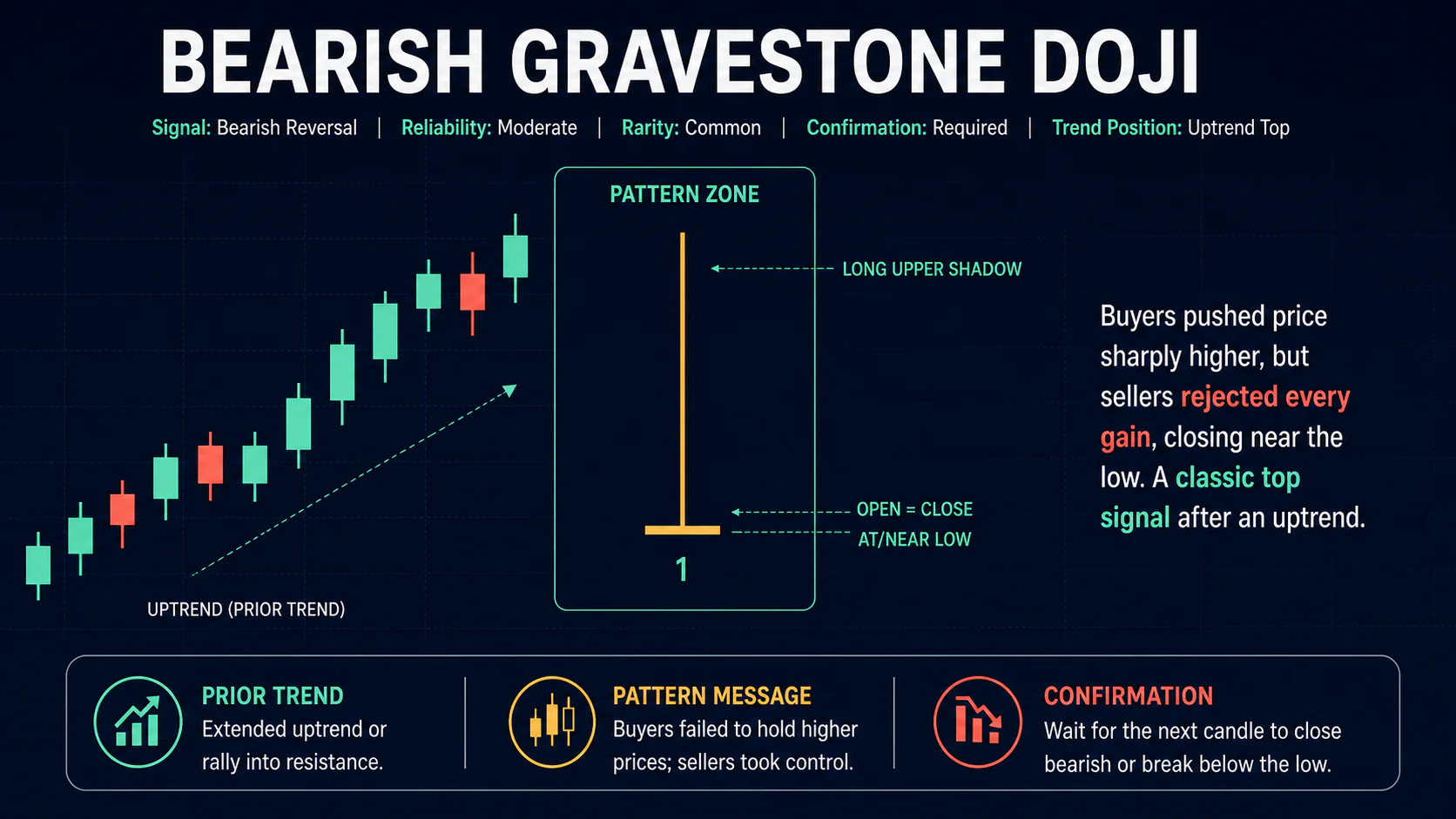
Doji structure: Open and close are equal or virtually equal, sitting at or near the session low.
Long upper shadow: A pronounced wick above the body shows a substantial intraday advance that was completely given back.
Minimal lower shadow: Little to no wick below the body — sellers controlled the entire lower portion of the range and the close.
Trend context: The pattern has reversal significance mainly after an extended uptrend or at a recognizable resistance level; the identical shape appearing in a downtrend is generally read as a bullish signal instead (see the bullish gravestone doji).
Market Psychology
Buyers push the session higher, seemingly extending the trend, but sellers absorb that entire advance and take the close back to the open and the low. The close near the session low is what makes this pattern more decisive than a plain doji — it shows sellers didn't just neutralize the buyers, they fully reversed the intraday advance. That said, a single session of rejection doesn't prove a trend change on its own, which is why confirmation from a following bearish session strengthens the case considerably.
Variations
Near-perfect gravestone: Open and close within a hair of each other rather than exactly equal — the psychological impact is essentially the same.
Gap-up gravestone: The session opens with a gap higher before forming the gravestone shape, often read as a failed breakout attempt and a somewhat stronger version of the pattern.
Trading the Pattern
Entry
Wait for the next session to confirm — a close below the gravestone's low, ideally with a gap down, before entering short. Patterns forming at an established resistance level deserve more weight than ones forming in open space.
Stop Loss
Place stops above the gravestone's high; any close back above that level invalidates the bearish read.
Profit Targets
Nearby support levels are the most reasonable targets. Some traders project the length of the upper shadow downward from the low as a rough guide, but treat this as an estimate rather than a rule.
Combining With Indicators
The signal carries more weight when RSI or stochastic readings are overbought, when MACD is showing negative divergence, or when the pattern forms at a major moving average or prior high. None of these are required, but a gravestone doji with several of them present is a more credible setup than one appearing without any supporting context.
Common Mistakes
- Treating every gravestone-shaped candle as automatically bearish, regardless of whether it appears after an uptrend or a downtrend.
- Skipping confirmation and shorting immediately off the doji itself.
- Accepting candles with a meaningful lower shadow, or a body that isn't genuinely small, as valid gravestone dojis.
- Ignoring volume and resistance context, which do more to separate strong setups from weak ones than the candle shape alone.
FAQs
Is a gravestone doji always bearish?
It's bearish specifically when it appears after an uptrend or at resistance. The same shape after a downtrend is normally read as a bullish signal.
How is a gravestone doji different from a shooting star?
A shooting star also has a small body with a long upper shadow, but its open and close don't need to be identical the way a true doji's do — a gravestone doji is effectively a shooting star where the body has collapsed to nearly nothing.
Do I need to wait for confirmation?
Yes. A single gravestone doji shows rejection at the highs, but a following bearish session that breaks the doji's low provides much stronger evidence that sellers are actually in control.
What's the opposite of a gravestone doji?
The dragonfly doji, which has a long lower shadow instead of an upper one and is conventionally a bullish signal at market bottoms.
Conclusion
The gravestone doji is one of the more intuitive reversal candles — a clean visual of buyers pushing higher only to be completely overrun by sellers. Its value comes from that structure and from where it forms, not from any fixed success rate. Look for it at resistance, wait for confirmation, and size positions according to how much supporting context is actually present.