Bearish Upside Gap Two Crows
Updated Aug 26, 2026 · Reviewed by Terence Scott, founder
- Signal
- Bearish Reversal
- Reliability
- Moderate
- Rarity
- Rare
- Confirmation
- Required
- Trend Position
- Uptrend Top
- Best Timeframes
- Daily+
On this page
The Bearish Upside Gap Two Crows is a rare three-candle reversal pattern that forms after an uptrend. A strong bullish candle is followed by a candle that gaps up on the open but closes bearish, then a second bearish candle that opens within that candle's body and closes lower still — yet both black candles remain above the first candle's high, leaving the gap unfilled. The two dark candles hovering above an open gap give the pattern its name and its warning quality, and because the setup is uncommon, confirmation matters more here than it does for most reversal patterns.
Recognizing the Pattern
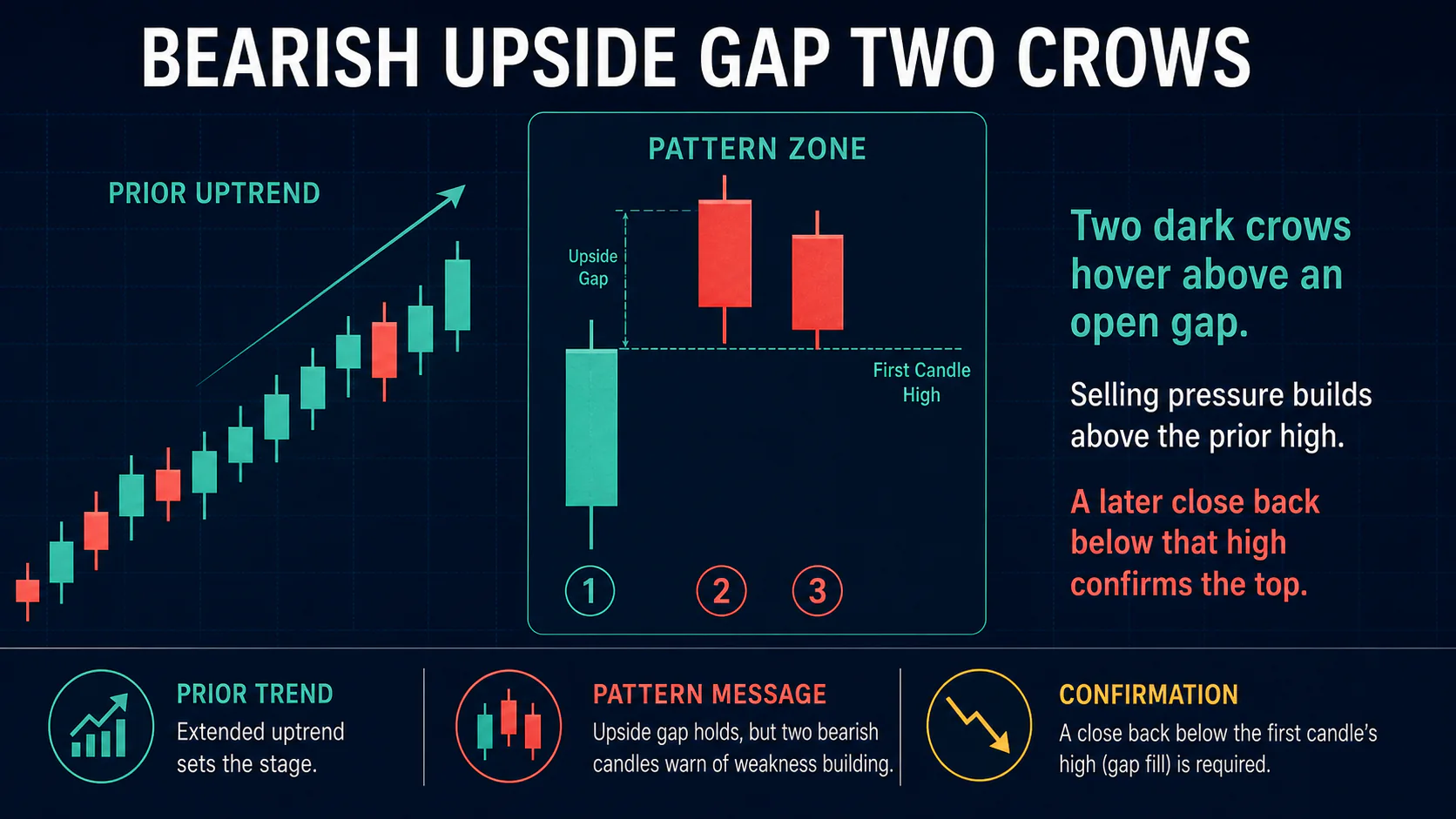
First candle: a strong bullish candle establishing clear upward momentum, ideally after an extended uptrend.
Second candle: opens with a gap above the first candle's high, suggesting continued strength, but closes as a bearish candle.
Third candle: opens within the second candle's real body and closes lower, but the entire pattern — both black candles — stays above the first candle's high, meaning the original gap is never filled during the three-candle formation.
The unfilled gap is the pattern's defining and most counterintuitive feature: it looks bullish, since price is still gapped above the prior high, even as two consecutive bearish candles build selling pressure underneath. That tension is what the pattern trades on, and it is why confirmation matters more here than with most reversal patterns.
Notable Variations
A larger initial gap tends to produce a more psychologically significant pattern, since the eventual failure represents a bigger reversal of sentiment. Formation near a well-tested resistance level or a round number adds further confluence, and versions where the second bearish candle shows a notably larger real body than the first are generally read as a stronger sign of building selling pressure.
Quick Recognition Checklist
- Extended uptrend precedes the pattern
- First candle is a strong bullish candle
- Second candle gaps above the first candle's high, then closes bearish
- Third candle opens within the second candle's body and closes lower still
- Both black candles remain above the first candle's high — the gap stays unfilled
- A later close back below the first candle's high (gap fill) is required for confirmation
Market Psychology
The pattern captures a specific kind of hidden weakness: an uptrend that gaps higher in apparent strength while selling quietly builds underneath it.
The Gap-Up Open: Genuine Optimism
- Traders bid the stock higher, short sellers cover, and momentum buyers chase strength
- The gap itself often reflects a burst of enthusiasm around news or technical breakout expectations
First Bearish Candle: A Reality Check
- Despite the enthusiastic open, sellers show up and the session closes lower
- The close still remains above the old high, so the bullish backdrop appears intact
Second Bearish Candle: Quiet Confirmation
- Selling pressure keeps building even while the gap holds
- This is the kind of quiet deterioration beneath an apparently strong tape that can precede more serious weakness
As long as the gap remains unfilled, some traders still view it as support; a subsequent break below it tends to trigger more decisive selling as that assumption fails.
Trading the Pattern
Entry
Because the gap stays open throughout the three-candle formation, most traders wait for a later close back below the first candle's high — filling the gap — before entering short, since that is the clearest signal the pattern's bullish underpinning has failed. More aggressive traders enter on the third candle's close with a tight stop, anticipating the gap fill.
Stop-Loss
A stop above the pattern's high, typically the second candle's high, is standard for gap-fill entries; a stop at the gap level itself works for the more aggressive approach.
Profit Targets
The minimum target is a full fill of the gap; from there, the next support level below or a downward projection of the gap's size gives a reasonable extended target.
Confirmation and Indicator Confluence
The pattern is strongest when RSI is overbought heading into the gap, when MACD shows bearish divergence during the formation, or when the gap occurs near a significant resistance level or Fibonacci extension.
Because gap-fill confirmation is central to trading this pattern, waiting for it — rather than acting on the three-candle formation alone — meaningfully improves the odds of a successful trade. The speed of the eventual gap fill is itself informative: a fill that happens quickly, within a session or two, tends to reflect more urgent selling than one that takes a week or more to develop.
Broader context is also worth checking before committing to a trade: a stock showing this pattern while its sector or the wider market is also stalling adds confidence that the weakness is not isolated. Declining volume through the uptrend leading into the gap, followed by a volume pickup on the bearish candles, is a classic distribution signature worth watching for.
Common Mistakes
- Treating the unfilled three-candle formation alone as a sell signal — the gap-fill confirmation is what separates a real setup from a premature one.
- Confusing this pattern with the plain Two Crows, where the second black candle closes back inside the first candle's body rather than staying above it.
- Ignoring how long the gap holds — a gap that fills quickly is generally viewed as a stronger, more urgent bearish signal.
- Sizing positions as if this were a high-frequency, high-certainty pattern rather than a rare one requiring patience for confirmation.
- Placing stops without accounting for a possible retest of the pattern's high before the gap ultimately fills.
- Forgetting that the pattern can simply fail — a gap that never fills and instead sees new highs means the bullish trend never actually broke down.
FAQs
What makes this different from the plain Bearish Two Crows?
In this pattern, both black candles remain above the first candle's high and the gap stays unfilled through the three-candle formation. In the plain Two Crows, the second black candle closes back inside the first candle's body.
Why does the gap matter so much here?
The unfilled gap acts as a psychological support level. As long as it holds, some buyers see it as confirmation of ongoing strength; its eventual fill is what invalidates that view and often triggers accelerated selling.
Is confirmation really necessary before trading this pattern?
Given how rare the pattern is and how the gap can persist for several sessions before filling, entering without waiting for the gap-fill confirmation significantly increases the risk of a failed trade.
How rare is this pattern in practice?
It's one of the less frequently seen candlestick reversal patterns, since it requires a specific sequence: a gap up, two consecutive bearish closes, and both staying above the prior high.
What would tell me the pattern has failed?
A resumption of new highs above the second candle's high, without the gap ever filling, suggests the bullish trend has reasserted itself.
How long can the gap stay open before the pattern is considered invalid?
There's no fixed rule, but the longer the gap holds without filling, the less relevant the original three-candle formation becomes to current price action — most traders lose interest in the setup after a week or two without a fill.
Does a larger gap make the pattern more reliable?
Generally yes. A larger gap represents a bigger burst of optimism that ultimately fails, which tends to produce a more psychologically significant — and often faster — reversal once the gap does fill.
Conclusion
The Bearish Upside Gap Two Crows describes a specific kind of hidden weakness: an uptrend that gaps higher in apparent strength while two consecutive bearish candles quietly build selling pressure underneath. The pattern is rare and requires patience — specifically, waiting for the gap to fill — but it offers a moderately reliable warning that an uptrend's apparent strength may not be as solid as the chart's highs suggest. Traders who wait for that gap-fill confirmation, rather than reacting to the three-candle shape alone, are best positioned to act on it.