Bearish Falling Three Methods
Updated Aug 26, 2026 · Reviewed by Terence Scott, founder
- Signal
- Bearish Continuation
- Reliability
- High
- Rarity
- Common
- Confirmation
- Recommended
- Trend Position
- Mid-Trend
On this page
The Bearish Falling Three Methods is a five-candle continuation pattern that shows a downtrend pausing briefly before resuming. A long bearish candle establishes the move, three small candles retrace part of it without ever leaving its range, and a final long bearish candle closes below the first candle's low, confirming that the pause was just that — a pause, not a reversal. It is one of the more dependable continuation patterns precisely because its confirmation step is so explicit.
Recognizing the Pattern
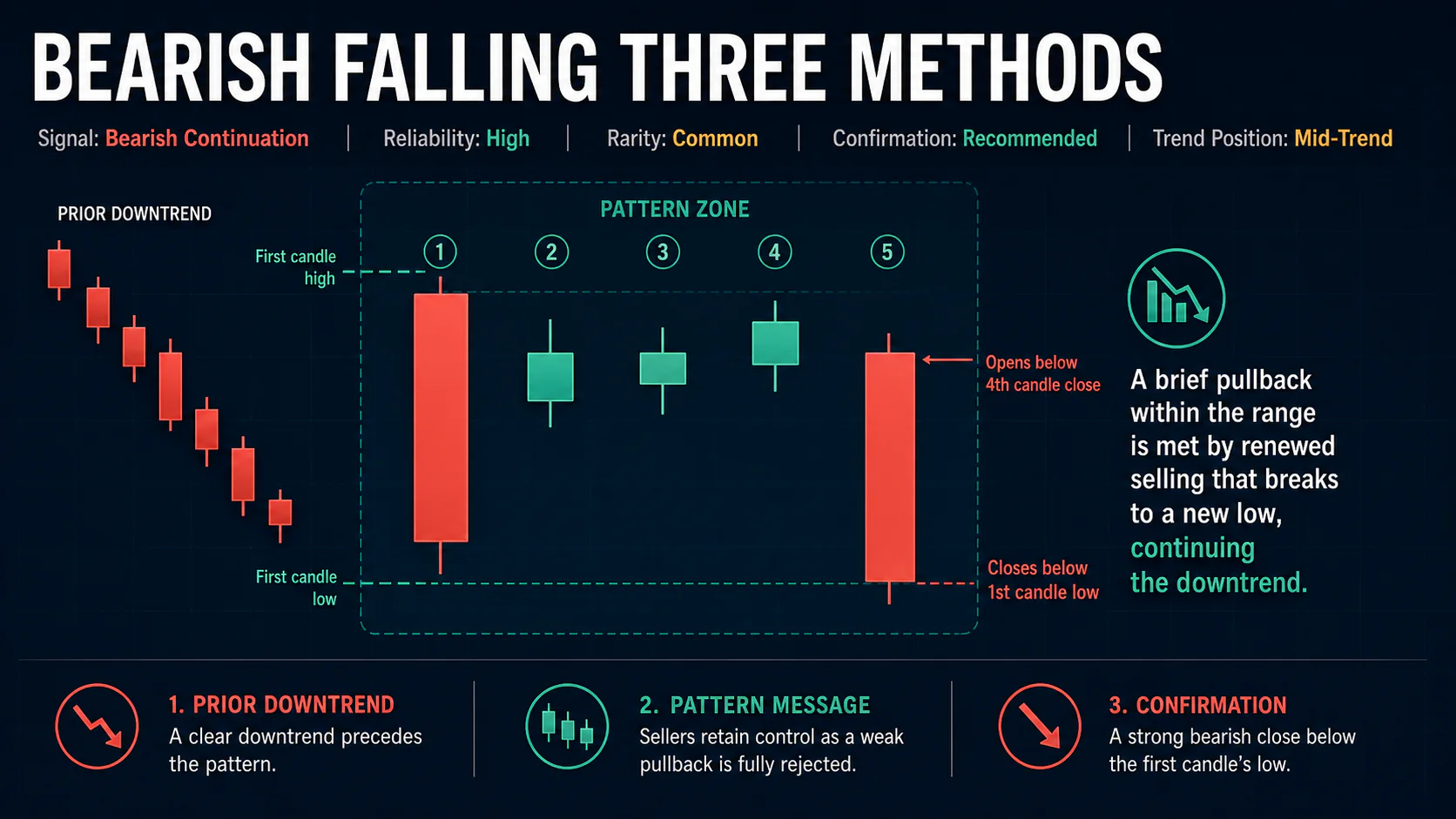
First candle: a long bearish candle representing a genuine decline, ideally on above-average volume.
Candles two through four: three small-bodied candles, typically bullish, that retrace part of the first candle's decline but stay contained within its high-to-low range.
Fifth candle: a long bearish candle that opens below the fourth candle's close and closes below the first candle's low, confirming that the downtrend has resumed.
The three middle candles must not close above the first candle's open or push below its low — if they break out of that range, the pattern doesn't apply. Volume that is heavier on the first and fifth candles and lighter through the retracement supports the idea that the pullback reflects weak, unconvinced buying rather than a genuine change in trend.
Quick Recognition Checklist
- Established downtrend precedes the first candle
- First candle is long and bearish, ideally on above-average volume
- Three small candles retrace part of the decline while staying inside the first candle's range
- Fifth candle opens below the fourth candle's close
- Fifth candle closes below the first candle's low
- Volume is lighter during the retracement than on the first and fifth candles
Notable Variations
A retracement made up of four small candles instead of three, but still fully contained within the first candle's range, is sometimes treated as an acceptable variation, though the classic definition uses exactly three. A fifth candle that opens with a gap down adds an extra layer of conviction to the continuation signal, and a retracement that includes a doji or two, rather than only small bullish bodies, generally signals even less conviction among the counter-trend buyers.
Market Psychology
The pattern reflects a downtrend that pauses just long enough to tempt bottom-fishers before resuming, without ever genuinely losing control to buyers.
First Candle: Sellers Firmly in Control
- Often driven by a technical breakdown or fresh selling pressure
- Above-average volume supports the idea of genuine institutional participation
Middle Candles: Half-Hearted Buying
- Short sellers take partial profits and bargain hunters test the water
- None of the buying carries enough conviction to erase the first candle's decline
- Volume typically stays light throughout this phase
Fifth Candle: The Question Is Settled
- Sellers step back in and push through the low of the original decline
- Confirms the brief pause never represented a genuine change in the balance of power
Trading the Pattern
Entry
Most traders enter once the fifth candle closes below the first candle's low with reasonable volume, treating that as confirmation the pause is over. A gap down on the fifth candle's open is an added sign of conviction and can support a slightly earlier entry.
Stop-Loss
A stop above the high of the three retracement candles is standard, since a move back above that range calls the whole pattern into question. Trailing the stop lower as the position moves favorably is a reasonable way to protect gains in what tends to be a fast-moving continuation.
Profit Targets
Targets are usually set by projecting the length of the first candle downward from the fifth candle's close, or simply by targeting the next meaningful support level. In strong, well-established downtrends, some traders hold a partial position with a trailing stop rather than fixing a single target.
Confirmation and Indicator Confluence
The pattern works best in a market already confirmed to be trending down — checking that RSI remains below 50 without dropping into oversold territory, or that MACD stays below its signal line through the retracement, both support the idea that the pause is temporary rather than the start of a genuine reversal.
Broader context also matters: a retracement that stalls right at a prior support level now acting as resistance, or one that coincides with sector-wide weakness, both reinforce the case for continuation over reversal.
It's also worth checking where the pattern sits within the larger downtrend. A Falling Three Methods that appears reasonably early in a decline has more room to run than one appearing after an extended, mature downtrend, where the odds of an eventual genuine bottom naturally rise regardless of any single pattern's signal.
Common Mistakes
- Trading before the fifth candle confirms — entering during the retracement is essentially guessing which way it resolves.
- Missing that one of the retracement candles has broken outside the first candle's range, which invalidates the pattern.
- Ignoring volume — heavy volume during the "weak" retracement candles undercuts the pattern's premise that buying interest is thin.
- Trading the pattern near major support, where the retracement has a better chance of turning into a genuine reversal.
- Setting profit targets that ignore nearby support levels that could stall the continuation.
- Assuming every three-candle pullback within a downtrend qualifies — the range containment and fifth-candle breakdown are both required, not optional extras.
- Holding onto the trade despite a stall in downward momentum after entry, rather than tightening the stop or taking partial profits when the expected follow-through doesn't materialize.
FAQs
Do the three middle candles have to be bullish?
Typically yes, but small-bodied or doji candles that stay within the first candle's range can also satisfy the pattern; what matters most is that they represent weak, contained counter-trend action.
What's the bullish equivalent of this pattern?
The Rising Three Methods is the mirror image — a long bullish candle, a contained pullback, and a final bullish candle to new highs, confirming an uptrend's continuation.
How many middle candles does the pattern require?
The classic version uses exactly three; variations with four small candles still contained within the first candle's range are sometimes treated as valid, though less textbook.
What invalidates the pattern?
If any of the retracement candles closes above the first candle's open, or the fifth candle fails to make a new low, the pattern hasn't completed as defined.
Is this considered a reliable pattern?
Yes — among continuation patterns, it's generally regarded as one of the more dependable ones, largely because it requires clear confirmation, the new low on the fifth candle, before signaling.
How quickly should the pattern complete?
There's no strict rule, but a retracement lasting more than a handful of sessions starts to look less like a brief pause and more like genuine consolidation, which weakens the pattern's reliability.
Does this pattern work equally well in individual stocks and indices?
Yes, the same logic applies to both, though indices tend to produce cleaner, less noisy versions of the pattern simply because they average out the idiosyncratic moves of individual constituents.
Conclusion
The Bearish Falling Three Methods gives trend-following traders a clear way to distinguish a genuine pause from a reversal: as long as the retracement stays contained and the fifth candle confirms with a new low, the pattern suggests the original downtrend has more room to run. Its reliance on a clean, well-defined confirmation step is what makes it one of the more dependable continuation signals available, and one worth learning well given how frequently it appears across individual stocks and broader indices alike.